 Links to the NRICH website Home page

30 April (Primary), 1 May (Secondary)
Resources tagged with: Practical activity
There are 151 NRICH Mathematical resources connected to Practical activity, you may find related items under Physical and digital manipulatives.
Broad Topics > Physical and digital manipulatives > Practical activity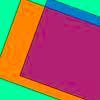
Move Those Halves
For this task, you'll need an A4 sheet and two A5 transparent sheets. Decide on a way of arranging the A5 sheets on top of the A4 sheet and explore ...



Constructing Triangles
Generate three random numbers to determine the side lengths of a triangle. What triangles can you draw?
How Tall?
A group of children are discussing the height of a tall tree. How would you go about finding out its height?
Bryony's Triangle
Watch the video to see how to fold a square of paper to create a flower. What fraction of the piece of paper is the small triangle?
Which Solids Can We Make?
Interior angles can help us to work out which polygons will tessellate. Can we use similar ideas to predict which polygons combine to create semi-regular solids?
Sociable Cards
Move your counters through this snake of cards and see how far you can go. Are you surprised by where you end up?

Attractive Rotations
Here is a chance to create some attractive images by rotating shapes through multiples of 90 degrees, or 30 degrees, or 72 degrees or...

The Hair Colour Game
The class were playing a maths game using interlocking cubes. Can you help them record what happened?

Next Size Up
The challenge for you is to make a string of six (or more!) graded cubes.
The Numbers Give the Design
Make new patterns from simple turning instructions. You can have a go using pencil and paper or with a floor robot.

Jig Shapes
Can you each work out what shape you have part of on your card? What will the rest of it look like?

Tower of Hanoi
The Tower of Hanoi is an ancient mathematical challenge. Working on the building blocks may help you to explain the patterns you notice.
It's a Tie
Kaia is sure that her father has worn a particular tie twice a week in at least five of the last ten weeks, but her father disagrees. Who do you think is right?
Music to My Ears
Can you predict when you'll be clapping and when you'll be clicking if you start this rhythm? How about when a friend begins a new rhythm at the same time?
Factors and Multiples Game
A game in which players take it in turns to choose a number. Can you block your opponent?
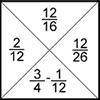
Fractions Jigsaw
A jigsaw where pieces only go together if the fractions are equivalent.
Cunning Card Trick
Delight your friends with this cunning trick! Can you explain how it works?
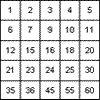
Factors and Multiples Puzzle
Using your knowledge of the properties of numbers, can you fill all the squares on the board?
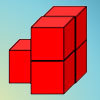
Brush Loads
How can you arrange the 5 cubes so that you need the smallest number of Brush Loads of paint to cover them? Try with other numbers of cubes as well.
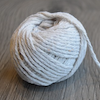
Stringy Quads
This practical problem challenges you to make quadrilaterals with a loop of string. You'll need some friends to help!

Sponge Sections
You have been given three shapes made out of sponge: a sphere, a cylinder and a cone. Your challenge is to find out how to cut them to make different shapes for printing.
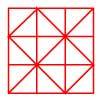
Fractional Triangles
Use the lines on this figure to show how the square can be divided into 2 halves, 3 thirds, 6 sixths and 9 ninths.

Let Us Reflect
Where can you put the mirror across the square so that you can still "see" the whole square? How many different positions are possible?
Triangles to Tetrahedra
Imagine you have an unlimited number of four types of triangle. How many different tetrahedra can you make?
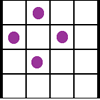
Square Corners
What is the greatest number of counters you can place on the grid below without four of them lying at the corners of a square?
Egyptian Rope
The ancient Egyptians were said to make right-angled triangles using a rope with twelve equal sections divided by knots. What other triangles could you make if you had a rope like this?

Nine Colours
Can you use small coloured cubes to make a 3 by 3 by 3 cube so that each face of the bigger cube contains one of each colour?
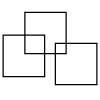
Three Squares
What is the greatest number of squares you can make by overlapping three squares?
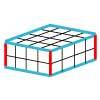
Making Cuboids
Let's say you can only use two different lengths - 2 units and 4 units. Using just these 2 lengths as the edges how many different cuboids can you make?
Hexagon Transformations
Can you cut a regular hexagon into two pieces to make a parallelogram? Try cutting it into three pieces to make a rhombus!
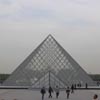
Pyramid Numbers
What are the next three numbers in this sequence? Can you explain why are they called pyramid numbers?
Two by One
An activity making various patterns with 2 x 1 rectangular tiles.

Cut and Make
Cut a square of paper into three pieces as shown. Now,can you use the 3 pieces to make a large triangle, a parallelogram and the square again?
Double Your Popcorn, Double Your Pleasure
We went to the cinema and decided to buy some bags of popcorn so we asked about the prices. Investigate how much popcorn each bag holds so find out which we might have bought.
Two Squared
What happens to the area of a square if you double the length of the sides? Try the same thing with rectangles, diamonds and other shapes. How do the four smaller ones fit into the larger one?
Fencing
Arrange your fences to make the largest rectangular space you can. Try with four fences, then five, then six etc.
Cutting Corners
Can you make the most extraordinary, the most amazing, the most unusual patterns/designs from these triangles which are made in a special way?
Little Boxes
How many different cuboids can you make when you use four CDs or DVDs? How about using five, then six?
Hoops/rope
Ideas for practical ways of representing data such as Venn and Carroll diagrams.
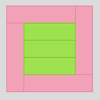
Cuisenaire Squares
These squares have been made from Cuisenaire rods. Can you describe the pattern? What would the next square look like?
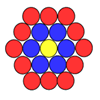
Counting Counters
Take a counter and surround it by a ring of other counters that MUST touch two others. How many are needed?
Matchsticks
Reasoning about the number of matches needed to build squares that share their sides.
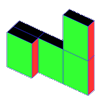
Cereal Packets
How can you put five cereal packets together to make different shapes if you must put them face-to-face?
Construct-o-straws
Make a cube out of straws and have a go at this practical challenge.
Polydron
This activity investigates how you might make squares and pentominoes from Polydron.
Counter Ideas
Here are some ideas to try in the classroom for using counters to investigate number patterns.
Tangrams
Can you make five differently sized squares from the interactive tangram pieces?