 Links to the NRICH website Home page

30 April (Primary), 1 May (Secondary)
Resources tagged with: Games
There are 94 results
Broad Topics > Physical and digital manipulatives > Games
Rhombus It
Players take it in turns to choose a dot on the grid. The winner is the first to have four dots that can be joined to form a rhombus.



Parallelogram It
Players take it in turns to choose a dot on the grid. The winner is the first to have four dots that can be joined to form a parallelogram.
Statement Snap
You'll need to know your number properties to win a game of Statement Snap...
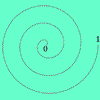
Spiralling Decimals
Take turns to place a decimal number on the spiral. Can you get three consecutive numbers?

Charlie's Delightful Machine
Here is a machine with four coloured lights. Can you develop a strategy to work out the rules controlling each light?
Dicey Operations
Who said that adding, subtracting, multiplying and dividing couldn't be fun?

Nice or Nasty
There are nasty versions of this dice game but we'll start with the nice ones...

Countdown
Here is a chance to play a version of the classic Countdown Game.

The Remainders Game
Play this game and see if you can figure out the computer's chosen number.

Diamond Collector
Collect as many diamonds as you can by drawing three straight lines.

Factors and Multiples Game
A game in which players take it in turns to choose a number. Can you block your opponent?
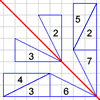
Transformation Game
Why not challenge a friend to play this transformation game?
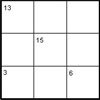
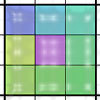
Diagonal Sums Sudoku
Solve this Sudoku puzzle whose clues are in the form of sums of the numbers which should appear in diagonal opposite cells.
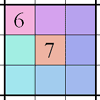
Diagonal Product Sudoku
Given the products of diagonally opposite cells - can you complete this Sudoku?

Property Chart
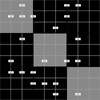
A game in which players take it in turns to try to draw quadrilaterals (or triangles) with particular properties. Is it possible to fill the game grid?
Shapely Pairs
A game in which players take it in turns to turn up two cards. If they can draw a triangle which satisfies both properties they win the pair of cards. And a few challenging questions to follow...

Quadrilaterals Game
A game for 2 or more people, based on the traditional card game Rummy.

Fractions and Percentages Card Game
Can you find the pairs that represent the same amount of money?

Square It
Players take it in turns to choose a dot on the grid. The winner is the first to have four dots that can be joined to form a square.

Got It
A game for two people, or play online. Given a target number, say 23, and a range of numbers to choose from, say 1-4, players take it in turns to add to the running total to hit their target.

Matching Fractions, Decimals and Percentages
Can you match pairs of fractions, decimals and percentages, and beat your previous scores?


Have You Got It?
Can you explain the strategy for winning this game with any target?


Jam
To avoid losing think of another very well known game where the patterns of play are similar.

One, Three, Five, Seven
A game for 2 players. Set out 16 counters in rows of 1,3,5 and 7. Players take turns to remove any number of counters from a row. The player left with the last counter looses.
Fifteen
Can you spot the similarities between this game and other games you know? The aim is to choose 3 numbers that total 15.
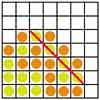
Low Go
A game for 2 players. Take turns to place a counter so that it occupies one of the lowest possible positions in the grid. The first player to complete a line of 4 wins.

Snail Trails
This is a game for two players. Does it matter where the target is put? Is there a good strategy for winning?
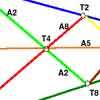
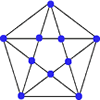
Pentanim
A game for 2 players with similarities to NIM. Place one counter on each spot on the games board. Players take it is turns to remove 1 or 2 adjacent counters. The winner picks up the last counter.

Slippery Snail
A game for two people, who take turns to move the counters. The player to remove the last counter from the board wins.
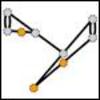
Sprouts
A game for 2 people. Take turns joining two dots, until your opponent is unable to move.

Mulinello Quadrupio
A game from Italy. Play with a friend and see if you can be the first to get five pieces in a line.

Dominoes
Everthing you have always wanted to do with dominoes! Some of these games are good for practising your mental calculation skills, and some are good for your reasoning skills.
Squayles
A game for 2 players. Given an arrangement of matchsticks, players take it is turns to remove a matchstick, along with all of the matchsticks that touch it.

Sz'kwa
This Chinese game for two players is a simple version of Wei ch'i or Go. Each player has 20 distinctive pieces - try coins, pebbles, shells. You could try marking the board out in wet sand.

Two Stones
This game is known as Pong hau k'i in China and Ou-moul-ko-no in Korea. Find a friend to play or try the interactive version online.

Patience
A simple game of patience which often comes out. Can you explain why?
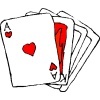
Stop or Dare
All you need for this game is a pack of cards. While you play the game, think about strategies that will increase your chances of winning.
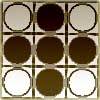
Turnablock
A simple game for 2 players invented by John Conway. It is played on a 3x3 square board with 9 counters that are black on one side and white on the other.

Football World Cup Simulation
A maths-based Football World Cup simulation for teachers and students to use.

Yih or Luk Tsut K'i or Three Men's Morris
Some puzzles requiring no knowledge of knot theory, just a careful inspection of the patterns. A glimpse of the classification of knots and a little about prime knots, crossing numbers and knot arithmetic.
Nim
Start with any number of counters in any number of piles. 2 players take it in turns to remove any number of counters from a single pile. The loser is the player who takes the last counter.