 Links to the NRICH website Home page

30 April (Primary), 1 May (Secondary)
Resources tagged with: Networks/graph theory
There are 29 results
Broad Topics > Decision mathematics and combinatorics > Networks/graph theory
A Curious Collection of Bridges
Read about the problem that tickled Euler's curiosity and led to a new branch of mathematics!

Round-robin Scheduling
Think about the mathematics of round robin scheduling.


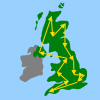
The Olympic Torch Tour
Imagine you had to plan the tour for the Olympic Torch. Is there an efficient way of choosing the shortest possible route?
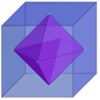
The Four Colour Theorem
The Four Colour Conjecture was first stated just over 150 years ago, and finally proved conclusively in 1976. It is an outstanding example of how old ideas can be combined with new discoveries. prove a mathematical theorem.
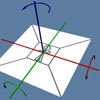
Symmetric Tangles
The tangles created by the twists and turns of the Conway rope trick are surprisingly symmetrical. Here's why!
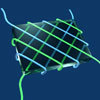
Tangles
A personal investigation of Conway's Rational Tangles. What were the interesting questions that needed to be asked, and where did they lead?
Going Places with Mathematicians
This article looks at the importance in mathematics of representing places and spaces mathematics. Many famous mathematicians have spent time working on problems that involve moving and mapping things.
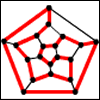
Some Circuits in Graph or Network Theory
Eulerian and Hamiltonian circuits are defined with some simple examples and a couple of puzzles to illustrate Hamiltonian circuits.
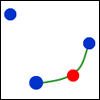
Sprouts Explained
This article invites you to get familiar with a strategic game called "sprouts". The game is simple enough for younger children to understand, and has also provided experienced mathematicians with significant food for thought.
Dice, Routes and Pathways
This article for teachers discusses examples of problems in which there is no obvious method but in which children can be encouraged to think deeply about the context and extend their ability to think mathematically, especially geometrically.

The Bridges of Konigsberg
Investigate how networks can be used to solve a problem for the 18th Century inhabitants of Konigsberg.

Tourism
If you can copy a network without lifting your pen off the paper and without drawing any line twice, then it is traversable. Decide which of these diagrams are traversable.
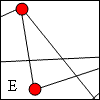
Travelling Salesman
A Hamiltonian circuit is a continuous path in a graph that passes through each of the vertices exactly once and returns to the start. How many Hamiltonian circuits can you find in these graphs?
Königsberg
Can you cross each of the seven bridges that join the north and south of the river to the two islands, once and once only, without retracing your steps?
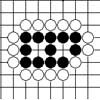
Sufficient but Not Necessary: Two Eyes and Seki in Go
The game of go has a simple mechanism. This discussion of the principle of two eyes in go has shown that the game does not depend on equally clear-cut concepts.
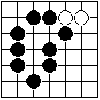
Behind the Rules of Go
This article explains the use of the idea of connectedness in networks, in two different ways, to bring into focus the basics of the game of Go, namely capture and territory.
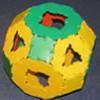
Classifying Solids Using Angle Deficiency
Toni Beardon has chosen this article introducing a rich area for practical exploration and discovery in 3D geometry

Ding Dong Bell
The reader is invited to investigate changes (or permutations) in the ringing of church bells, illustrated by braid diagrams showing the order in which the bells are rung.
Geometry and Gravity 2
This is the second of two articles and discusses problems relating to the curvature of space, shortest distances on surfaces, triangulations of surfaces and representation by graphs.
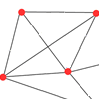
Only Connect
The graph represents a salesman’s area of activity with the shops that the salesman must visit each day. What route around the shops has the minimum total distance?

Pattern of Islands
In how many distinct ways can six islands be joined by bridges so that each island can be reached from every other island...
Fermat's Poser
Find the point whose sum of distances from the vertices (corners) of a given triangle is a minimum.
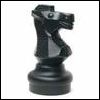
Knight Defeated
The knight's move on a chess board is 2 steps in one direction and one step in the other direction. Prove that a knight cannot visit every square on the board once and only (a tour) on a 2 by n board for any value of n. How many ways can a knight do this on a 3 by 4 board?
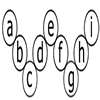
Magic W
Find all the ways of placing the numbers 1 to 9 on a W shape, with 3 numbers on each leg, so that each set of 3 numbers has the same total.
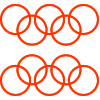
Olympic Magic
in how many ways can you place the numbers 1, 2, 3 … 9 in the nine regions of the Olympic Emblem (5 overlapping circles) so that the amount in each ring is the same?


Magic Caterpillars
Label the joints and legs of these graph theory caterpillars so that the vertex sums are all equal.

Network Trees
Explore some of the different types of network, and prove a result about network trees.
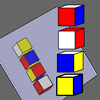
Instant Insanity
Given the nets of 4 cubes with the faces coloured in 4 colours, build a tower so that on each vertical wall no colour is repeated, that is all 4 colours appear.