 Links to the NRICH website Home page

30 April (Primary), 1 May (Secondary)
Resources tagged with: Nets
There are 15 results
Broad Topics > 3D geometry, shape and space > Nets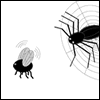
The Spider and the Fly
A spider is sitting in the middle of one of the smallest walls in a room and a fly is resting beside the window. What is the shortest distance the spider would have to crawl to catch the fly?


Tet-trouble
Is it possible to have a tetrahedron whose six edges have lengths 10, 20, 30, 40, 50 and 60 units?
Which Face?
Which faces are opposite each other when this net is folded into a cube?
Cool as Ice
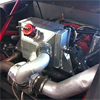
Design and construct a prototype intercooler which will satisfy agreed quality control constraints.

Gym Bag
Can Jo make a gym bag for her trainers from the piece of fabric she has?

Make Your Own Pencil Case
What shape would fit your pens and pencils best? How can you make it?

Chopped Dice
Can you make a new type of fair die with 14 faces by shaving the corners off a cube?
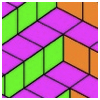
Auditorium Steps
What is the shape of wrapping paper that you would need to completely wrap this model?
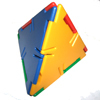
Air Nets
Can you visualise whether these nets fold up into 3D shapes? Watch the videos each time to see if you were correct.

All Is Number
Read all about Pythagoras' mathematical discoveries in this article written for students.

Thinking 3D
How can we as teachers begin to introduce 3D ideas to young children? Where do they start? How can we lay the foundations for a later enthusiasm for working in three dimensions?
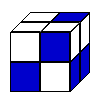
Cubic Conundrum
Which of the following cubes can be made from these nets?
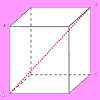
Cutting a Cube
A half-cube is cut into two pieces by a plane through the long diagonal and at right angles to it. Can you draw a net of these pieces? Are they identical?
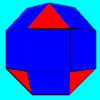
Rhombicubocts
Each of these solids is made up with 3 squares and a triangle around each vertex. Each has a total of 18 square faces and 8 faces that are equilateral triangles. How many faces, edges and vertices does each solid have?
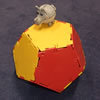
Platonic Planet
Glarsynost lives on a planet whose shape is that of a perfect regular dodecahedron. Can you describe the shortest journey she can make to ensure that she will see every part of the planet?