 Links to the NRICH website Home page

30 April (Primary), 1 May (Secondary)
Resources tagged with: Polynomial functions and their roots
There are 23 results
Broad Topics > Coordinates, functions and graphs > Polynomial functions and their roots
Curve Fitter
This problem challenges you to find cubic equations which satisfy different conditions.



Spinners
How do scores on dice and factors of polynomials relate to each other?

Telescoping Functions
Take a complicated fraction with the product of five quartics top and bottom and reduce this to a whole number. This is a numerical example involving some clever algebra.

Exploring Cubic Functions
Quadratic graphs are very familiar, but what patterns can you explore with cubics?

Mechanical Integration
To find the integral of a polynomial, evaluate it at some special points and add multiples of these values.
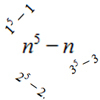
Common Divisor
Find the largest integer which divides every member of the following sequence: 1^5-1, 2^5-2, 3^5-3, ... n^5-n.

Root to Poly
Find the polynomial p(x) with integer coefficients such that one solution of the equation p(x)=0 is $1+\sqrt 2+\sqrt 3$.

Polynomial Relations
Given any two polynomials in a single variable it is always possible to eliminate the variable and obtain a formula showing the relationship between the two polynomials. Try this one.
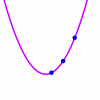
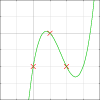
Interpolating Polynomials
Given a set of points (x,y) with distinct x values, find a polynomial that goes through all of them, then prove some results about the existence and uniqueness of these polynomials.

Patterns of Inflection
Find the relationship between the locations of points of inflection, maxima and minima of functions.

Symmetrically So
Exploit the symmetry and turn this quartic into a quadratic.
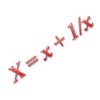
The Why and How of Substitution
Step back and reflect! This article reviews techniques such as substitution and change of coordinates which enable us to exploit underlying structures to crack problems.

Agile Algebra
Observe symmetries and engage the power of substitution to solve complicated equations.

Fibonacci Fashion
What have Fibonacci numbers to do with solutions of the quadratic equation x^2 - x - 1 = 0 ?

Poly Fibs
A sequence of polynomials starts 0, 1 and each poly is given by combining the two polys in the sequence just before it. Investigate and prove results about the roots of the polys.

An Introduction to Galois Theory
This article only skims the surface of Galois theory and should probably be accessible to a 17 or 18 year old school student with a strong interest in mathematics.
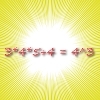
Janine's Conjecture
Janine noticed, while studying some cube numbers, that if you take three consecutive whole numbers and multiply them together and then add the middle number of the three, you get the middle number. Does this always work? Can you prove or disprove this conjecture?
Cubic Spin
Prove that the graph of f(x) = x^3 - 6x^2 +9x +1 has rotational symmetry. Do graphs of all cubics have rotational symmetry?

More Polynomial Equations
Find relationships between the polynomials a, b and c which are polynomials in n giving the sums of the first n natural numbers, squares and cubes respectively.

Two Cubes
Two cubes, each with integral side lengths, have a combined volume equal to the total of the lengths of their edges. How big are the cubes? [If you find a result by 'trial and error' you'll need to prove you have found all possible solutions.]
Janusz Asked
In y = ax +b when are a, -b/a, b in arithmetic progression. The polynomial y = ax^2 + bx + c has roots r1 and r2. Can a, r1, b, r2 and c be in arithmetic progression?
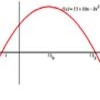
Real(ly) Numbers
If x, y and z are real numbers such that: x + y + z = 5 and xy + yz + zx = 3. What is the largest value that any of the numbers can have?