 Links to the NRICH website Home page

30 April (Primary), 1 May (Secondary)
Resources tagged with: Complex numbers
There are 22 NRICH Mathematical resources connected to Complex numbers, you may find related items under Place value and the number system.
Broad Topics > Place value and the number system > Complex numbers
Complex Partial Fractions
To break down an algebraic fraction into partial fractions in which all the denominators are linear and all the numerators are constants you sometimes need complex numbers.


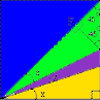
Three by One
There are many different methods to solve this geometrical problem - how many can you find?
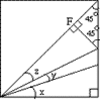
8 Methods for Three by One
This problem in geometry has been solved in no less than EIGHT ways by a pair of students. How would you solve it? How many of their solutions can you follow? How are they the same or different? Which do you like best?
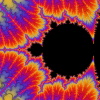
Adventures with Complex Numbers
This collection is designed to give an introductory taste of complex numbers.

Strolling Along
What happens when we multiply a complex number by a real or an imaginary number?

Sheep in Wolf's Clothing
Can you work out what simple structures have been dressed up in these advanced mathematical representations?

Impedance Can Be Complex!
Put your complex numbers and calculus to the test with this impedance calculation.
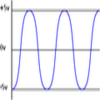
Pumping the Power
What is an AC voltage? How much power does an AC power source supply?
What Are Numbers?
Ranging from kindergarten mathematics to the fringe of research this informal article paints the big picture of number in a non technical way suitable for primary teachers and older students.

Two and Four Dimensional Numbers
Matrices and Complex Numbers combine to enable us to create four dimensional numbers.
Sextet
Investigate x to the power n plus 1 over x to the power n when x plus 1 over x equals 1.


What Are Complex Numbers?
This article introduces complex numbers, brings together into one bigger 'picture' some closely related elementary ideas like vectors and the exponential and trigonometric functions and their derivatives and proves that e^(i pi)= -1.
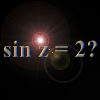
Complex Sine
Solve the equation sin z = 2 for complex z. You only need the formula you are given for sin z in terms of the exponential function, and to solve a quadratic equation and use the logarithmic function.
Cube Roots
Evaluate without a calculator: (5 sqrt2 + 7)^{1/3} - (5 sqrt2 - 7)^1/3}.
Napoleon's Theorem
Triangle ABC has equilateral triangles drawn on its edges. Points P, Q and R are the centres of the equilateral triangles. What can you prove about the triangle PQR?
Complex Rotations
Choose some complex numbers and mark them by points on a graph. Multiply your numbers by i once, twice, three times, four times, ..., n times? What happens?
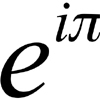
An Introduction to Complex Numbers
A short introduction to complex numbers written primarily for students aged 14 to 19.
Target Six
Show that x = 1 is a solution of the equation x^(3/2) - 8x^(-3/2) = 7 and find all other solutions.

Roots and Coefficients
If xyz = 1 and x+y+z =1/x + 1/y + 1/z show that at least one of these numbers must be 1. Now for the complexity! When are the other numbers real and when are they complex?