Tony sent us his answers to the first
parts.
(a) $6$ units squared ($=3\times 2-0\times 5$)
(b) $12$ units squared ($=3\times 4-2\times 0$)
(c)$9$ units squared ($=4\times 3-1\times 3$)
(d)$10$ units squared ($=2\times 3-4\times -1$)
James, Jamie and George from Gillingham
School sent us their formula for the area of the general
parallelogram.
$a d-b c$.
Here's one way to work that out.
Remember that
and
.
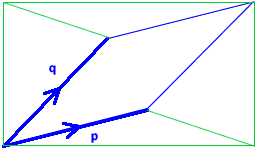
The diagram shows the parallelogram inside a rectangle with base
and height
. This rectangle has area
. If we could find
the areas of the triangles outside the parallelogram, then we could subtract
them from the area of the rectangle to find the area of the parallelogram.
The bottom triangle has height
and base
, so has area
.
The triangle on the right has (if you imagine it on its side so that its
base is at the bottom) height
and base
, so has area
.
The triangle at the top is congruent to the triangle at the bottom (it has
been rotated by
), so has area
.
The triangle on the left is congruent to the triangle on the right,
so has area
.
So the area of the parallelogram is
,
just as James, Jamie and George said.