

Consecutive Numbers


An investigation involving adding and subtracting sets of consecutive numbers. Lots to find out, lots to explore.
Problem
Consecutive Numbers printable sheet
I wonder how often you have noticed numbers that follow one after another: 1, 2, 3 ... etc.? Sometimes they appear in reverse order when a countdown is happening for a launch of a rocket. But usually they happen in order going up, like when you read through a book and notice the page numbers. These kinds of numbers - whole numbers that follow one after another - are called consecutive numbers.
This investigation uses the idea of consecutive numbers and gives us other numbers to explore. You may very well discover things that no-one else has discovered or written about before, and that's great!
This is how it starts. You need to choose any four consecutive numbers and place them in a row with space between them, like this:
4 5 6 7
When you've chosen your consecutive numbers, stick with the same ones for quite a while, exploring different ideas before you change them in any way. Now place $+$ and $-$ signs in between them, something like this:
4+5-6+7
4-5+6+7
and so on until you have found all the possibilities. Are you sure you've got them all? You should include one using all pluses and one that includes all minuses.
Now work out the answers to all your calculations (e.g. 4+5-6+7=10).
Next, try other sets of four consecutive numbers and look carefully at the sets of answers that you get each time.
Are you surprised by anything you notice?
It is probably a good idea to write down your 'noticings'. This can lead you to test some ideas out by starting with new sets of consecutive numbers and seeing if the same things happen in the same way.
You might now be doing some predictions that you can test out...
Finally, it is good to ask the question "I wonder what would happen if I ... ?"
You may have thought up your own questions to explore further. Here are some we thought of:
"What would happen if I took the consecutive numbers in an order going down, instead of up?"
"What would happen if I only used sets of three consecutive numbers?"
"What would happen if I used more consecutive numbers?"
"What would happen if I changed the rule and allowed consecutive numbers to include fractions or decimals?"
"What would happen if I allowed a $+$ or $-$ sign before the first number?"
Getting Started
Having chosen your four consecutive numbers you place $+$ and $-$ signs in between them.
You have three empty spaces, so how many possible combinations are there for arranging the $+$ and $-$ signs?
Are you sure you have found them all? How will you know?
Student Solutions
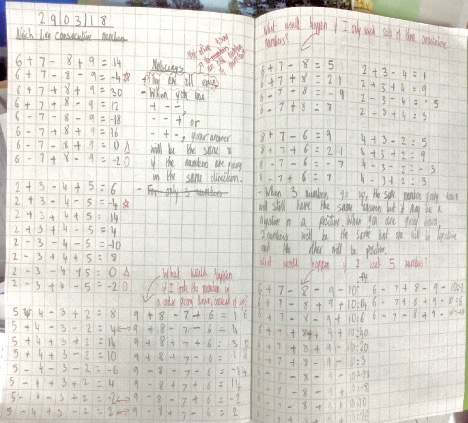
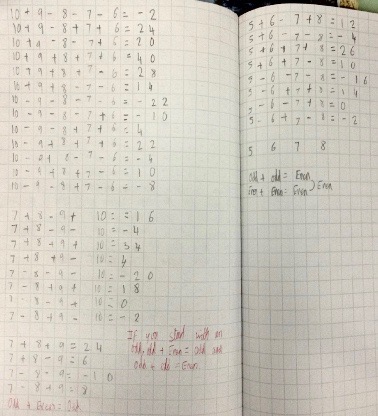
Kayley from Arnhem Wharf Primary School in London sent in this very good solution to the task:
When you use an even number of consecutive numbers, your answer will be even because there are two odd numbers and two even numbers in the equation. An odd number plus or minus another odd number equals an even number; an even number plus or minus an even number equals an even number; therefore the two answers (odd +/- odd and even +/- even) are even numbers and if you add it all together it will still be an even number.
I noticed that if you use the sequences +--, --+ or -+- with four consecutive numbers, your answer will be the same, no matter what consecutive numbers you use, if both sets numbers are ordered in the same way (e.g. from smallest to biggest). A set of three consecutive numbers will have odd answers if the starting number is even because an even number add or subtract an odd number will be odd, then when you add or subtract another odd number the answer will be odd.
I also found out that if there is a set of three consecutive numbers, and the starting number is odd, all the answers will be even because an odd plus/minus an even number is odd and if you plus/minus an odd number, the answer will be even.
These pictures show her work, the red writing being her thoughts. Larger versions can be viewed here: First page and Second page


Iris, Hannah, Hayden and Tawana from Fenstanton and Hilton Primary School said:
We worked out the calculations for 1, 2, 3, 4 as our consecutive numbers. These are the calculations we worked out:
1+2+3+4= 10; 1+2+3-4= 2; 1+2-3-4= -4; 1-2-3-4= 4;
1-2-3+4= -2; 1-2-3-4= -8; 1-2-3+4= 0; 1-2+3+4= 6
Are you surprised by anything you noticed? We noticed that all the numbers are even, which would make sense because if you are adding consecutive numbers there will always be two odd numbers and two even, which means they will always add up to an even number.
What would happen if you had the numbers going in descending order instead of ascending order? We found out that when we put the numbers in descending order they were all still even and that some of the numbers were there same but mostly different.
We got:
4+3+2+1=10; 4+3+2-1=8; 4+3-2-1=4; 4-3-2-1=-2
4-3-2+1=0: 4-3+2+1=4; 4+3-2+1=6; 4-3+2-1=2
James and Polly from the very small Meavy CE Primary School sent in this excellent solution:
Our answer to the consecutive numbers challenge:
30-31-32-33=-66 and 30+31+32+33=126 are some of the questions only using adding and subtraction using the numbers 30, 31, 32, 33. You can only get eight different calculations:
1. + + +; 2. + + -; 3. + - +; 4. + - -
5. - + +; 6. - + -; 7. - - +; 8. - - -
We found out that the answers you always get are 0, -2 and -4 using - - + (in any order).
If you put something in the middle of the eight answers, once you have put them in order, the gap between the answers will be like a mirror image.
We did the problem four times so that we could make sure that our answer was right. These were the groups of numbers we used:
| The numbers we started with | The eight answers | The gaps between the answers |
| 1,2,3,4 | 10,6,4,2,0,-2,-4,-8 | 4,2,2,2,2,2,4 |
| 7,8,9,10 | 34,18,16,14,0,-2,-4,-20 | 16,2,2,14,2,2,16 |
| 20,21,22,23 | 86,44,42,40,0,-2,-4,-46 | 42,2,2,40,2,2,42 |
| 30,31,32,33 | 126,64,62,60,0,-2,-4,-66 | 62,2,2,60,2,2,62 |
James thinks that the middle number in the gaps is double the start number and the outside numbers are double the second number. Polly thinks the middle number in the gaps is double the start number but the outside numbers are double the first number and add two. Both of our suggestions are right.
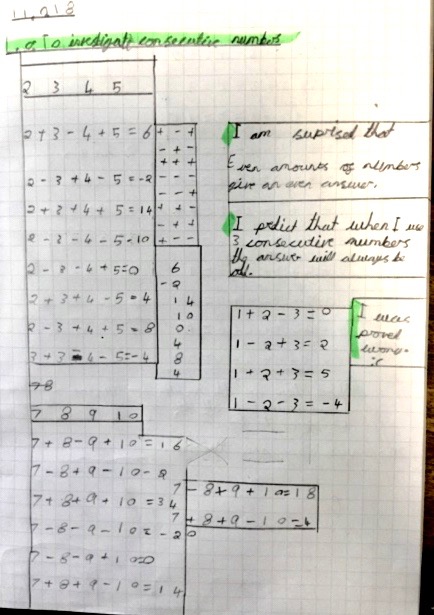
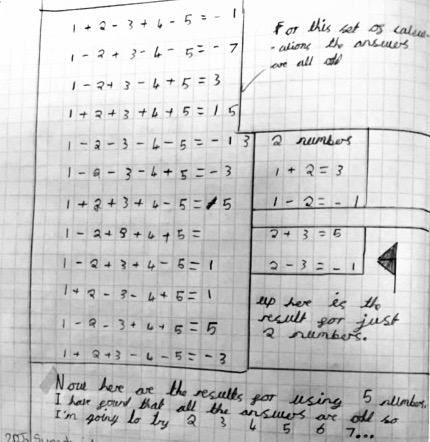
Mrs Bromley a teacher at Skelton Primary School, York sent in Joseph's work, saying,
This morning we really enjoyed investigating consecutive numbers using your resource.
She remembered that Joseph said:
I decided to investigate odd and even numbers. I was surprised that even amounts of numbers give an even answer. I predicted that using three consecutive numbers would always give odd answers but I was proved wrong! Next, I would like to look at what happens if you start with an odd or even number.


You can see Joseph's work more clearly as .jpg files here and here.
Thank you all for these really helpful solutions which may encourage others to pursue the same task.
Teachers' Resources
Consecutive Numbers
Well I wonder how often you have noticed that there are numbers around the place that follow one after another 1, 2, 3 ... etc.? Sometimes they appear in reverse order when a countdown is happening for a launch of a rocket. But usually they happen in an order going up, like when you read through a book and notice the page numbers. These kinds of numbers are called consecutive numbers, you may have heard of the word before - it simply means that they are whole numbers that follow one after another.
This investigation uses the idea of consecutive numbers and gives us other numbers to explore. You may very well discover things that NO ONE else has discovered or written about before, and that's GREAT!
So this is how it starts. You need to choose any four consecutive numbers and place them in a row with a bit of a space between them, like this:

When you've chosen your consecutive numbers, stick with those same ones for quite a while, exploring ideas before you change them in any way. Now place $+$ and $-$ signs in between them, something like this :
4 + 5 - 6 + 7
4 - 5 + 6 + 7
and so on until you have found all the possibilities. Are you sure you've got them all? You should include one using all $+$'s and one that includes all $-$'s.
Now work out the answers to all your calculations (e.g. 4 - 5 + 6 + 7 = 12 and so on).
Now try other sets of four consecutive numbers and look carefully at the sets of answers that you get each time.
Are you surprised by anything you notice?
It is probably a good idea to write down your 'noticings'. This can lead you to test some ideas out by starting with new sets of consecutive numbers and seeing if the same things happen in the same way.
You might now be doing some predictions that you can test out...
FINALLY, it is good to ask the question "I wonder what would happen if I ... ?"
You may have thought up your own questions to explore further. Here are some we thought of:
"What would happen if I took the consecutive numbers in an order going down, instead of up?"
"What would happen if I only used sets of three consecutive numbers?"
"What would happen if I used more consecutive numbers?"
"What would happen if I changed the rule and allowed consecutive numbers to include fractions or decimals?"
"What would happen if I allowed a $+$ or $-$ sign before the first number?"
Using NRICH Tasks Richly describes ways in which teachers and learners can work with NRICH tasks in the classroom.
Why do this problem?
This problem has the capacity to interest young and old alike. It offers an element of surprise which makes learners curious to investigate further and want to explain. I have used it with a wide range of attainment levels, and new things keep on being found out. It is a fantastic context in which to look for patterns, explain why these patterns occur, and as a result, to gain a deeper understanding of our number system. It offers opportunities to work together by sharing results and making decisions as to which consecutive numbers to look at next.
Possible approach
To introduce the problem, discuss what consecutive means, and invite pupils to suggest a starting number. Let them select the three operations and take four or five examples, but don't discuss how many possibilities there are at this stage. Give children time to find other possibilities and encourage them to explain how they know they have them all.
Once all eight have been agreed on, let learners choose other sets of consecutive numbers to investigate. It is sometimes useful to suggest to the class that they are being detectives and seeking out links, relationships and reasons. Listen out for expressions of surprise, which you could proble a little by asking learners why they are surprised and how that makes them feel towards the task.
Most children find some connections between the eight answers that they find in each case. This could be that all the answers are even or the fact that some results appear with every group of four consecutive numbers. Encourage pupils to explain why in each case.
Key questions
Possible support
On the odd occasions that pupils needed support I have found that putting a number of pupils together to work as a sharing group is helpful.
Possible extension
I have found that all the students who have been involved in this investigation have got very excited as various observations are made, patterns seen and questions asked. The most enjoyable times for me have been hearing ten year olds using their own form of algebra and coming to some powerful realisations about why every one has a $0$, $-2$ and $-4$.
The problem has also been the starting point for some pupils to be able to ask "I wonder what would happen if ...?", as suggested at the end of the problem itself. For consideration of negative numbers as well, look at Consecutive Negative Numbers.
For more extension work