 Links to the NRICH website Home page

30 April (Primary), 1 May (Secondary)
Properties of Shapes KS2
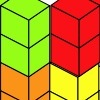
Triple Cubes


This challenge involves eight three-cube models made from interlocking cubes. Investigate different ways of putting the models together then compare your constructions.

Four Triangles Puzzle
Cut four triangles from a square as shown in the picture. How many different shapes can you make by fitting the four triangles back together?
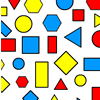
Sorting Logic Blocks
This activity focuses on similarities and differences between shapes.
Seeing Squares
Players take it in turns to choose a dot on the grid. The winner is the first to have four dots that can be joined to form a square.
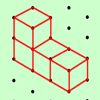
The Third Dimension
Here are four cubes joined together. How many other arrangements of four cubes can you find? Can you draw them on dotty paper?
Seeing Parallelograms
Players take it in turns to choose a dot on the grid. The winner is the first to have four dots that can be joined to form a parallelogram.
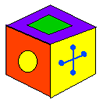
A Puzzling Cube
Here are the six faces of a cube - in no particular order. Here are three views of the cube. Can you deduce where the faces are in relation to each other and record them on the net of this cube?
Shape Draw
Use the information on these cards to draw the shape that is being described.
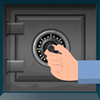
How Safe Are You?
How much do you have to turn these dials by in order to unlock the safes?
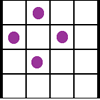
Square Corners
What is the greatest number of counters you can place on the grid below without four of them lying at the corners of a square?
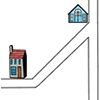
Six Places to Visit
Can you describe the journey to each of the six places on these maps? How would you turn at each junction?
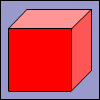
Building Blocks
Here are some pictures of 3D shapes made from cubes. Can you make these shapes yourself?
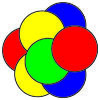
Counters in the Middle
This task depends on groups working collaboratively, discussing and reasoning to agree a final product.
Always, Sometimes or Never? Shape
Are these statements always true, sometimes true or never true?
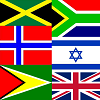
National Flags
This problem explores the shapes and symmetries in some national flags.

Round a Hexagon
This problem shows that the external angles of an irregular hexagon add to a circle.
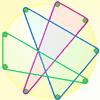
Nine-pin Triangles
How many different triangles can you make on a circular pegboard that has nine pegs?

Let Us Reflect
Where can you put the mirror across the square so that you can still "see" the whole square? How many different positions are possible?

Name That Triangle!
Can you sketch triangles that fit in the cells in this grid? Which ones are impossible? How do you know?
Bracelets
Investigate the different shaped bracelets you could make from 18 different spherical beads. How do they compare if you use 24 beads?

Guess What?
Can you find out which 3D shape your partner has chosen before they work out your shape?
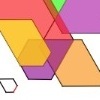
The Numbers Give the Design
Make new patterns from simple turning instructions. You can have a go using pencil and paper or with a floor robot.
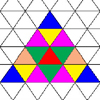
Where Are They?
Use the isometric grid paper to find the different polygons.
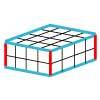
Making Cuboids
Let's say you can only use two different lengths - 2 units and 4 units. Using just these 2 lengths as the edges how many different cuboids can you make?

Sponge Sections
You have been given three shapes made out of sponge: a sphere, a cylinder and a cone. Your challenge is to find out how to cut them to make different shapes for printing.
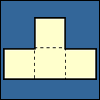
Cut Nets
Each of the nets of nine solid shapes has been cut into two pieces. Can you see which pieces go together?
Seeing Rhombuses
Players take it in turns to choose a dot on the grid. The winner is the first to have four dots that can be joined to form a rhombus.
Arranging Cubes
A task which depends on members of the group working collaboratively to reach a single goal.
Move Those Halves
For this task, you'll need an A4 sheet and two A5 transparent sheets. Decide on a way of arranging the A5 sheets on top of the A4 sheet and explore ...
Overlapping Again
What shape is the overlap when you slide one of these shapes half way across another? Can you picture it in your head? Use the interactivity to check your visualisation.

Egyptian Rope
The ancient Egyptians were said to make right-angled triangles using a rope with twelve equal sections divided by knots. What other triangles could you make if you had a rope like this?
Shapes on the Playground
Sally and Ben were drawing shapes in chalk on the school playground. Can you work out what shapes each of them drew using the clues?
Quad Match
A task which depends on members of the group noticing the needs of others and responding.
Stringy Quads
This practical problem challenges you to make quadrilaterals with a loop of string. You'll need some friends to help!
Cut it Out
Can you dissect an equilateral triangle into 6 smaller ones? What number of smaller equilateral triangles is it NOT possible to dissect a larger equilateral triangle into?
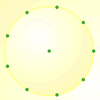
Quadrilaterals
How many DIFFERENT quadrilaterals can be made by joining the dots on the 8-point circle?

Triangles All Around
Can you find all the different triangles on these peg boards, and find their angles?
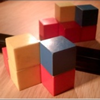
Reflector ! Rotcelfer
Can you place the blocks so that you see the reflection in the picture?

Olympic Turns
This task looks at the different turns involved in different Olympic sports as a way of exploring the mathematics of turns and angles.
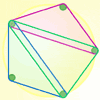
Board Block Challenge
Choose the size of your pegboard and the shapes you can make. Can you work out the strategies needed to block your opponent?
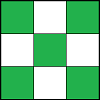
Symmetry Challenge
How many symmetric designs can you make on this grid? Can you find them all?
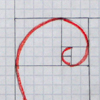
Making Spirals
Can you make a spiral for yourself? Explore some different ways to create your own spiral pattern and explore differences between different spirals.
Stick Images
This task requires learners to explain and help others, asking and answering questions.
What Shape?
This task develops spatial reasoning skills. By framing and asking questions a member of the team has to find out what mathematical object they have chosen.
Making Rectangles
A task which depends on members of the group noticing the needs of others and responding.

You may also be interested in this collection of activities from the STEM Learning website, that complement the NRICH activities above.