Links to the NRICH website Home page

30 April (Primary), 1 May (Secondary)
Counting and Ordering KS1

Counting Collections in the Early Years
In this article for practitioners, Cath Gripton and Deliah Pawluch explore the 'counting collections' approach, which encourages children to spend time playing and experimenting with counting.

Number Book
Creating a 'Book of Four' provides an opportunity for children to collect groups of four objects and consider how the groups of objects are similar.

Counting Collections
In this activity, children choose collections of items to count and are supported as they find ways to keep track of, and record, their counting.

Estimation Station
This activity involves filling a jar with small objects to encourage estimation and counting skills.

Using Books: Maisy Goes Camping
In this task, the book 'Maisy Goes Camping' by Lucy Cousins introduces children to the idea of using the size and number of objects to work out how many will fit in a 'tent'.

Tidying
When tidying away toys in this activity, children will use their counting skills to check that all the toys are in the box.

The Voting Station
This task encourages children to count and compare numbers when using 'voting bricks' to vote for a book at story time.

Number Rhymes
In this activity, the rhyme 'Ten Green Bottles' is used to encourage children to count backwards to work out how many bottles are left.

Incey Wincey
In this game, children roll the dice and count how many steps to move the spider up or down the drainpipe.

Beat the Clock
Children use everyday language to talk about time, to compare quantities and to solve problems

Five Steps to 50


Use five steps to count forwards or backwards in 1s or 10s to get to 50. What strategies did you use?

Biscuit Decorations
Andrew decorated 20 biscuits to take to a party. He lined them up and put icing on every second biscuit and different decorations on other biscuits. How many biscuits weren't decorated?

All Change
There are three versions of this challenge. The idea is to change the colour of all the spots on the grid. Can you do it in fewer throws of the dice?
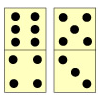
Writing Digits
Lee was writing all the counting numbers from 1 to 20. She stopped for a rest after writing seventeen digits. What was the last number she wrote?

Robot Monsters
Use these head, body and leg pieces to make Robot Monsters which are different heights.

Same Length Trains
How many trains can you make which are the same length as Matt's and Katie's, using rods that are identical?

Buzzy Bee
Buzzy Bee was building a honeycomb. She decorated the honeycomb with a pattern using numbers. Can you discover Buzzy's pattern and fill in the empty cells for her?
Missing Middles
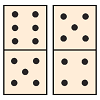
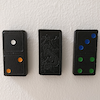
Can you work out the domino pieces which would go in the middle in each case to complete the pattern of these eight sets of three dominoes?
Making Sticks
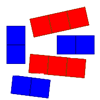
Kimie and Sebastian were making sticks from interlocking cubes and lining them up. Can they make their lines the same length? Can they make any other lines?

Grouping GoodiesLive
Pat counts her sweets in different groups and both times she has some left over. How many sweets could she have had?

How Would We Count?
An activity centred around observations of dots and how we visualise number arrangement patterns.
That Number Square
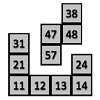
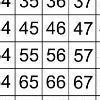
How quickly can you put back the numbers on the hundred square? What's the 'best' way to do it?