

Folding Squares


The diagonal of a square intersects the line joining one of the unused corners to the midpoint of the opposite side. What do you notice about the line segments produced?
Problem
Start with a square...
Image
| Image
| Image
| Image
|
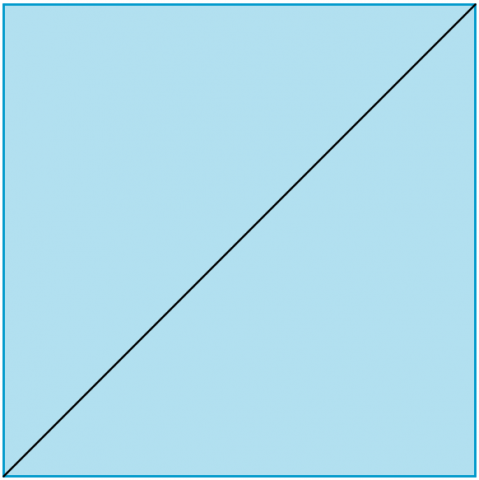
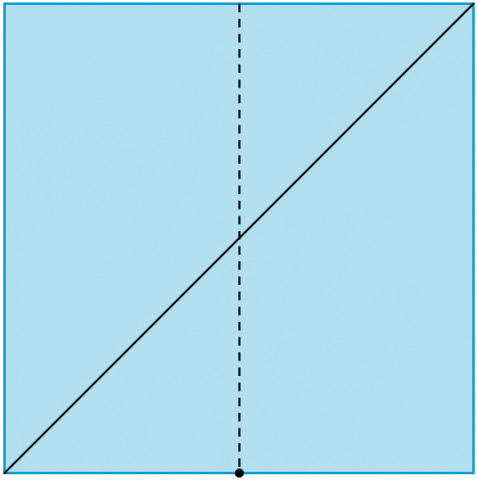
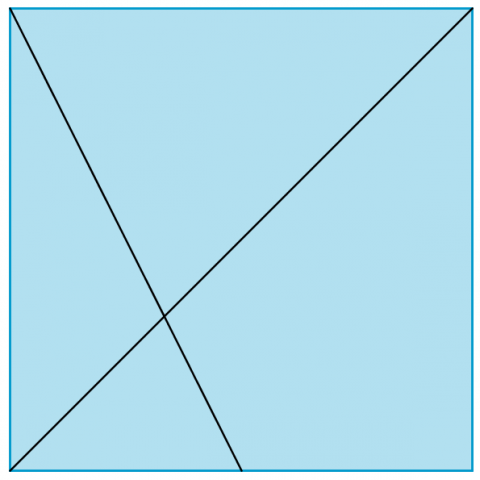
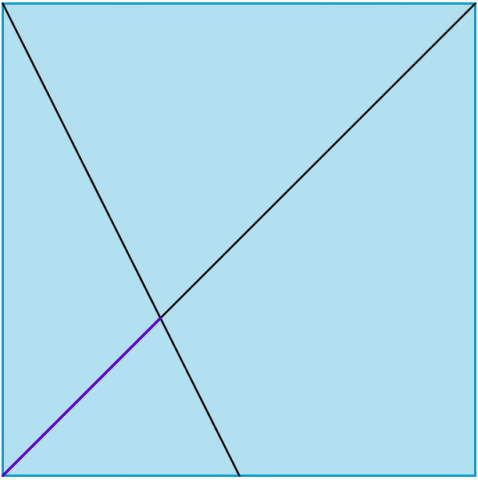
Fold to create a diagonal running from bottom left to top right. | Find the midpoint of the base by folding. | Fold the paper again, joining the top left corner to the midpoint of the base. | What fractions of the diagonal do you think your new fold has created? |
Is this what you expected?
Getting Started

Draw some squares and draw in a diagonal plus two lines joining one of the other two vertices to the midpoint of the opposite sides.
What do you notice?
Would this work with a rectangle, a parallelogram, a trapezium?
Student Solutions
Talei from Poltair Community School and Sports College sent in this excellent solution to the problem, showing the diagonals are split in the ratio 1:2 (or equivalently that the smaller part is a third of the whole)

FD = 2EF and FC = 2AF because . . .
We can prove that triangle FCD is an enlargement, by a scale factor of 2, of the triangle AEF.
The triangles' angles are the same - at point F the crossing lines give each triangle an identical angle because they are opposite each other. The line AC joins parallel lines to give an identical angle to each triangle because they are alternate, and the line ED works in the same way.
Therefore, because AE must be exactly half the length of CD, each line in triangle AEF will be half of its enlarged equivalent in triangle FCD.
FD = 2EF because FD is the enlarged equivalent line of EF in triangle AEF.
FC = 2AF because FC is the enlarged equivalent line of AF in triangle AEF.
Talei's method using similar triangles can also be applied to the general case for a pallelogram and arbitary intersection point:

$$\mathrm{\angle afe = \angle cfd \textrm{ (opposite angles) and } \angle eaf = \angle dcf \textrm{ (alternate / 'Z-' angles)}}$$
$$\mathrm{\therefore \triangle aef \textrm{ is similar to }\triangle cdf \Rightarrow \frac{cf}{af} = \frac{cd}{ae} \Rightarrow cf = \frac{cd}{ae}af}$$
$$\mathrm{ac = af + cf \Rightarrow ac = af \left( 1 + \frac{cd}{ae} \right)}$$
$$\mathrm{\therefore \ af = \frac{1}{1 + \frac{cd}{ae}} \textrm{ multiplying through by ae and using cd = ab} \Rightarrow af = \frac{ae}{ae + ab} ac}$$
Teachers' Resources
Using NRICH Tasks Richly describes ways in which teachers and learners can work with NRICH tasks in the classroom.
Why do this problem?
Possible approach
The last part of the question asks about other quadrilaterals. Some learners will be secure enough in the proof for squares to attempt to prove or disprove the cases for other quadrilaterals straight away without the need for accurate diagrams or folding.
Key questions
Possible extension
Possible support
The problem Two Ladders could be used to investigate similar triangles.