

A Very Shiny Nose?


This problem explores the biology behind Rudolph's glowing red nose, and introduces the real life phenomena of bacterial quorum sensing.
Problem

Each bacterial cell releases a signal molecule, $X$, at a rate of $1$ molecule per minute and if the concentration of $X$ is greater than or equal to $10^{11}$ molecules per ml, the bacteria will glow. $X$ decays with a half-life of $10$ minutes but the bacteria divide every $30$ minutes.
Sadly, Rudolph catches a nasty cold, which, by the time he is better, has killed all of the bacterial cells in his nose except for one. Santa is worried: there are only $24$ hours left until they need to set off to deliver Christmas presents. Will Rudolph's nose be glowing again in time?
If you need any data that is not included, try to estimate it: Santa wants an answer now, so that he can make alternative plans if need be.
This might sound far fetched, but bioluminesent bacteria which emit light only when there is a sufficient number of them exist in the real world, and are often found in symbiotic relationships with marine animals. The first of these to be studied was Aliivibrio fischeri (sometimes called Vibrio fischeri) which can be grown in the lab and observed to produce light only when large numbers of bacteria are present.
Read about the Hawaiian Bobtail Squid and its relationship with Aliivibrio fischeri.
Watch "How bacteria talk", a TED talk by Bonnie Bassler, for a description of how quorum sensing works (which also features the Hawaiian Bobtail Squid and Aliivibro fischeri).
Find out more about reindeer noses here.
Getting Started
If we assume the starting time is midnight one day, and they have to set off at midnight the next day, how many bacteria will we have at 00:30? How many at 02:00? How many at 23:30?
Since there is a half-life of 10 minutes (which means that every 10 minutes half of the molecules of $X$ disappear), you can probably ignore most of the $X$ produced until near the end of the 24 hours.
You will need an estimate for the volume of Rudolph's nose. You might like to model it as a sphere. You might find this webpage helpful.
Student Solutions
We've received several solutions to this problem including from Karim and Otto from London Academy of Excellence Tottenham, UK, Anya from Tanglin Trust School in Singapore, and Emily from Bishop's Wordsworth's Grammar School in the UK . Well done to Anya and Emily who found a complete solution to this problem. We also received some partial or incorrect solutions which contained interesting maths, so these are also shown below.
Anya from Tanglin Trust School in Singapore used the floor function to write the number of bacteria as a function of time ($x$) (click to enlarge):

Anya then used this to estimate the number of bacteria:

In fact, only half of substance X decays after 10 minutes. Anya assumes that all of it disappears after 10 minutes. This means Anya's total number of molecules of X will be an underestimate.

Anya has assumed that the volume of Rudolph's nose which is holds the bacteria and molecules of X is at least $1.4\times10^{15}\div10^{11}=14,000$ millilitres. That's probably reasonable!
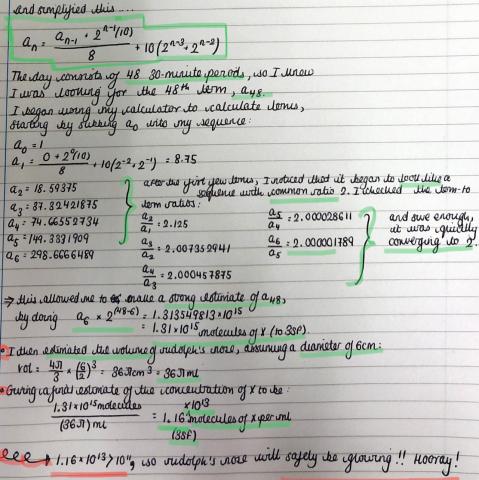
One important but tricky aspect of this problem is combining the time intervals for the bacteria dividing (30 mins) with the half life of $X$, which is only 10 minutes. Otto from London Academy of Excellence Tottenham in UK modelled the situation by focusing on the number of molecules of $X$ produced in the last half hour and dividing this by 8. In a different model, Emily from Bishop's Wordsworth's Grammar School in the UK used an iterative formula to estimate the number of bacteria every half hour (click to enlarge):
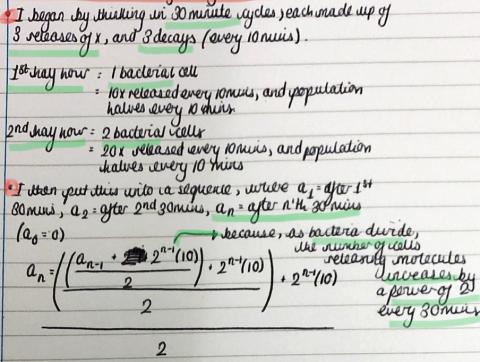
Emily's formula includes adding $2^n\times10$ for the molecules released in the first $10$ minutes (one molecule per bacterium per minute), and then dividing by $2$ after $10$ minutes have passed. Then in the next $10$ minutes, Emily adds $2^n\times10$ again and then divides by $2$ again. Emily repeats this for the third set of $10$ minutes in the half hour. This is an estimate, since in fact the molecules released one minute apart decay on a slightly different half-life cycle, but it is a good estimate.
Isabella from King's College London Maths School tried to represent the situation as a system of differential equations:


This is beautiful and a great way of expressing the situation. However, derivatives, or gradient, refer to the additive change in $Y$ every time $T$ increases, not the multiplicative change or "scale factor". This means you can't say that $$\frac{\text{d}Y}{\text{d}T}=1.0234Y$$ However, you can say that the rate of change of $Y$ is proportional to $Y$, so $$\frac{\text{d}Y}{\text{d}T}=kY$$ You can then use Isaella's method of supposing $Y=Ae^{\lambda}T.$ Differentiate this expression for $Y$ with respect to $T$ to see how $k,A$ and $\lambda$ are related, and then use $Y=1$ when $T=0$ and $Y=2$ when $T=30$ to find $A$ and $\lambda$.
In the equation for $\dfrac{\text{d}X}{\text{d}T},$ you can do the same for the first term. However, you cannot solve this equation easily: it is not separable. Isabella went on to "integrate" one term at a time, but the beauty of the system is that the molecules begin to decay as soon as they are emitted. Treating the terms separately does not capture this - the first term represents decay of $X$ and the second term represents creation of $X$ and if they are treated separately, the newly created molecules do not decay.
Teachers' Resources
Using NRICH Tasks Richly describes ways in which teachers and learners can work with NRICH tasks in the classroom.
Why do this problem?
This problem is based on real-life biology, and also includes the concept of half-life. Students will need to decide how to use the information that they are given, and will need to do some estimating.
The idea of bounds is very useful here. Students can try to find a number for $X$ which they know is an underestimate. They can also try and find an overestimate for the volume of Rudolph's nose.
You can download a word and pdf version of this problem.
Key Questions
- What do we know? What do we not know, which we need to know?
- How might we estimate what we don't know?
- How many bacteria do we have after 30 minutes? How many after 1 hour? How many at the end of the 24 hours?
- If we have $n$ bacteria, how many molecules of $X$ will have been emitted during a 10 minute period? Can you find an underestimate for the number of molecules of $X$ left at the end of the 10 minutes, assuming that the half life is 10 minutes.
- If we think of the molecules of $X$ emitted near the start of the 24 hours, most of them will have decayed by the end of the day, which means we can ignore any early molecules. At what point should we stop ignoring them?
This website gives the sizes of various sports ball which might be useful.
Possible Extension
Can you find an upper limit for the size of Rudolph's nose?