

Always a Multiple?


Think of a two digit number, reverse the digits, and add the numbers together. Something special happens...
Problem
Always a Multiple? printable worksheet
Watch the video to see Charlie's number trick.
If you can't play the video, you can read a description here.
Try a few examples for yourself. Do you always get a multiple of 11?
Can you explain why?
Alison and Charlie came up with their own explanations:
If you can't play the videos, you can read a description here.
Here are some similar number tricks.
Can you use Charlie's or Alison's representation to explain how they work?
Take any two-digit number. Reverse the digits, and subtract your answer from your original number. What do you notice?
Take any two-digit number. Add its digits, and subtract your answer from your original number. What do you notice?
Take any three-digit number. Reverse the digits, and subtract your answer from your original number. What do you notice?
- Take any five-digit number. Reverse the digits, and subtract your answer from your original number. What do you notice?
Once you've been able to explain what is going on above, you should be able to explain why many other similar tricks work.
Here is a selection you might like to try:
Getting Started
The Number Trick video:
Alison chose 42, added 24 and got the answer 66: "It is! How on earth did you know that?"
Charlie said: "I'm not sure. Let's try to work it out."
Alison's and Charlie's explanations videos:
She then put the four units with the four tens, and the two units with the two tens, giving six lots of eleven.
Charlie imagined a two-digit number $ab$, where $a$ represents the number in the tens column, and $b$ respresents the number in the units. This can be written as $10a+b$. Similarly, $ba$ can be written as $10b+a$.
Charlie added these together to get $11a+11b$, which he wrote as $11(a+b)$.
Student Solutions
Take any two-digit number. Reverse the digits, and subtract your answer from your original number. What do you notice?
Evie and Rose from Channing in the UK sent in an observation:
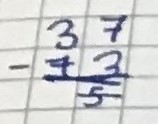
You notice that if the second digit is higher than the first, the total
will be a minus number and the opposite effect if the second number is
smaller.
Archisman from The Future Foundation School in India, Leopold from Kings School Al Barsha in UAE and Shriya from International School Frankfurt in Germany noticed something else. They explained it using Charlie's method. This is Shriya's work:
e.g. $72-27=45$
$45$ is a multiple of $9$.
e.g. $97-79=18$
$18$ is also a multiple of $9.$
This is why:
$(10a+b) -10b -a= 9a-9b$
Take any two-digit number. Add its digits, and subtract your answer from your original number. What do you notice?
Evie and Rose noticed that:
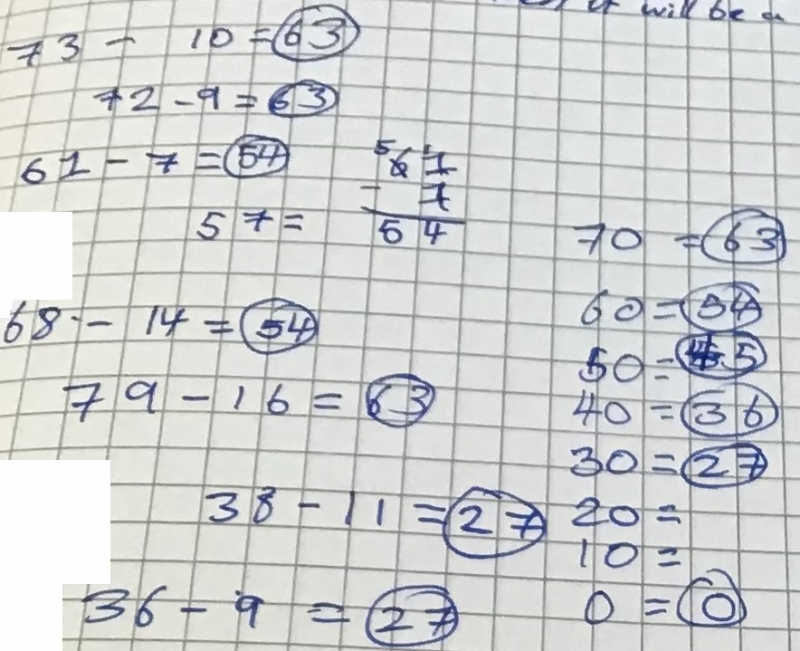
You notice that all the 'tens' have their own answer, and when the totals of each ten are put in order, they go up in nines. For example any number from 70 to 79 when put through the number trick, total up to 63, numbers from 80 to 89 total to 72 etc.
Monel and Rasel, from Globe Academy, explained why:
If you have $36$ (for example) and you take away the units digit first, then you will always get a multiple of $10.$
If you then take away the tens digit you will get a multiple of $9$ (because $3\times10 - 3\times1 = 3\times9).$
Leopold, Shriya and Archisman all explained this using Charlie's method. This is Archisman's work:
Let the number be $10x+y$
Sum of digits $=x+y$
Original number $-$ Sum of digits $=10x+y-(x+y)$
$=10x+y-x-y$
$=9x$
Hence,we observe that the result is a multiple of $9$ or to be more specific $9$ multiplied by the tens digit of the number.
Example: $92-11=81$ which is $9$ multiplied by $9$ (the tens digit of the number)
Take any three-digit/five-digit number. Reverse the digits, and subtract your answer from your original number. What do you notice?
Leopold, Archisman and Shriya investigated these questions using Charlie's method. Here is Leopold's work:
| HUNDRED | TEN | UNIT |
|---|---|---|
| $A$ | $B$ | $C$ |
| $C$ | $B$ | $A$ |
$100A+10B+C\\
100C+10B+A\\
(100A+10B+C)-(100C+10B+A)\\
=99A-99C\\
=99(A-C)\\
=11(9A-9C)\\
=9(11A-11C)$
Thus it will always lead to a multiple of $99,11$ and $9.$
Five digits:
| TEN THOUSAND | THOUSAND | HUNDRED | TEN | UNIT |
| $A$ | $B$ | $C$ | $D$ | $E$ |
| $E$ | $D$ | $C$ | $B$ | $A$ |
$10000A+1000B+100C+10D+E\\
10000E+1000D+100C+10B+A\\
(10000A+1000B+100C+10D+E)-(10000E+1000D+100C+10B+A)\\
=99,999A+990B-990D-99,999E\\
=9(11,111A+110B-110D-11,111E)$
Thus it will alway be a multiple of nine
Archisman and Shriya found more factors in the five digit case. This is Shriya's work:
$(10000a+1000b+100c+10d+e) -10000e -1000d -100c -10b -a\\= 9999a+990b-990d-9999e$
$9999$ and $990$ are multiples of $9$ and $11.$
And Archisman concluded:
$9999x+990y-990a-9999b =99(101x+10y-10a-101b)$
Hence,we observe that the result is a multiple of $9,11$ and $99 $.
Example: $54321-12345=41976$ which is a multiple of $9,11,99$
Teachers' Resources
Using NRICH Tasks Richly describes ways in which teachers and learners can work with NRICH tasks in the classroom.
Why do this problem?
This problem uses a number trick which will intrigue students, and then uses this curiosity as a context to introduce a useful algebraic technique which can be applied to a wide variety of related problems. By switching between a numerical and an algebraic representation, students can gain a clearer understanding of our place value system.
Possible approach
This printable worksheet may be useful: Always a Multiple?.
"Think of a two-digit number and write it down."
"Reverse the digits and add your answer to your original number."
"What answers did you get?"
Collect a few students' answers together and write them up on the board.
"Does anyone notice anything interesting?" "Multiples of 11."
"Does anyone have an answer that isn't a multiple of 11?"
"With your partner, without trying all possible two-digit numbers, try to find a convincing explanation why it will always work."
Give students some time to explore the problem. While they are working, circulate and listen for useful insights. Then bring the class together and share ideas.
If Alison's and Charlie's explanations from the video aren't offered, demonstrate them or show the video.
Students could be invited to work backwards - for example, what two-digit numbers can be reversed and added together to give 154 (a multiple of 11)?
"These methods can be used for lots of similar number tricks. Here are a few more. Work with your partner to figure out what each trick does, and then use different representations to explain why the tricks work."
If appropriate, bring the class together to share explanations for why each trick works, or ask them to present their clear explanations on a poster to display.
Finally, challenge students to devise their own number tricks using similar structures, and to test them out on each other.
You may wish to show the Number Jumbler to see if your students can explain how it works. Perhaps you could show it at the start of the lesson (without an explanation) and then again at the end of the lesson once they have the tools to deconstruct it.
Possible support
Diagonal Sums provokes a need to use place value to solve the problem, and could be a good foundation for this activity.
Possible extension
These problems can all be solved using similar techniques:
Special Numbers
Think of Two Numbers
Legs Eleven
Puzzling Place Value