What does your first lesson with a new class look like? Mine always
features a paired games activity. You can tell so much from
observing the children playing a simple game. When the whole class
is playing the same (or very similar) game, you and any support
staff are able to focus on observing the children and getting a
feel for their understanding of, and attitude to, mathematics.
Having made myself a class observation list, I set up the headings
so that I only need to add a quick tick or cross, though I do leave
room for a comment too. The choice of game depends on the year
group, but needs to be a fairly straightforward one, leaving you
free to circulate and listen in.
After a quick warm up, explain the game and allow the children to
pair up with whoever they wish. Put copies of the game with
sufficient dice and counters in the middle of the tables so that
the children have to organise themselves.
Reception and Year 1
Use any simple track game, for example
Incey Wincey
Spider or
Tug of War. If the
track is numbered and has optional routes so that children have to
make decisions, so much the better. Look out for children who:
- Organise themselves
- Take turns
- Move the correct number of spaces
- Include the space the player is on as the beginning of the
count
- Follow the numbers
- Can play with a variety of children
- Could be potential talk partners
Ask questions about what
number the player will land on if they throw a 2, or 5 etc. Listen
out for allegations of cheating. What has the accused done? What is
the accuser saying has happened? Allegations and responses
sometimes reveal misunderstandings about how to play the game.
Year 2 to Year 4
It just has to be snakes
and ladders. Make sure the children know how to play - more and
more children do not. Play in pairs. Look out for the same skills
as above, but focus on whether or not the children follow the
numbers correctly, particularly at the end of each row. You can
bring in higher-order thinking skills by throwing two dice:
children can choose which dice they use, or they could
add/subtract the numbers on the dice so that decision-making is
also involved. This is great played as a knockout contest to
find the class Snakes and Ladders Champion. As players are knocked
out and watch new games, listen to their comments. Are they
supportive of each other? Do they encourage, remind and advise?
Listen out for allegations of cheating as above.
Years 5 and 6
There are plenty of games
on NRICH to give you ideas, for example:
Strike It Out,
First Connect
Three,
Got
It! ... . Alternatively, you could download or access a version
of 'Who wants to be a millionaire?' from the internet. Board games
such as 'Trilemma', 'What's the Point?', 'Sum it up', 'Nubble!' or
'Triolet', my favourite, are useful. Most are four-player games so
you do not need many copies for a class set. Alternatively, some
have computer versions. Pool resources from other classes and check
out which games are on your school system. Look out for all the
characteristics mentioned above, as well as any knowledge needed to
play the game. 'What's the point?' uses decimals, fractions and
percentages, whilst 'Trilemma' includes questions about prime
numbers, factors, square numbers and square roots and more. Watch
out for those who need support. Do they receive help from the other
players?
My second session usually
involves a digit game. Can the children play with numbers? Use
their first solution to find others? Explore and test their ideas?
I usually specify that they must work with someone they did not
work with yesterday so that I can see how other pairings and
groupings work.
Reception and Year 1
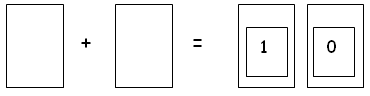
After you have explored
the children's understanding of digits, give a set of digit cards
per pair and ask them to make 10. Demonstrate first. They must use
the one and the zero to make ten, a good test in itself, then
explore ways of solving the calculation. Provide sticks of 10
interlocking cubes for support. Challenge the more able by
including a third number to add to make 10 or by moving the
calculation around to make 10 - ? = ? or by removing the
stipulation that the total must be 10.
Look out for children who
can:
- Organise themselves
- Take turns
- Discuss solutions
- Record their solutions clearly
- Use the previous solution to make a new one
Children who worked well
together on both days could be potential talk partners.
Year 2 to Year 4
Play 'The Digit Game' as
a starter. With one set of digit cards, challenge the class to beat
you. You will need to decide whether you are playing to make the
highest or lowest numbers. Pick a digit out of a bag without
looking and decide where to place it. Verbalise your thinking to
model the process for the children. Once placed, digits cannot be
moved! It might be better to make three-digit numbers in Year 2,
challenging those who are working well to move on to four digits.
Who won? How much did they win by? What is the difference between
the winning number and the highest number possible? Did the placed
digits make the highest/lowest number possible with those digits?
Could they be rearranged to make a higher/lower number? There are
many questions you can ask and the answers tell you a great deal
about the children's understanding of and facility with numbers.

The children can then
play in pairs, making the highest number, lowest number, nearest to
5000 etc. Ask them to come up with their own versions for others to
try. At the end of the session, discuss who liked which particular
version and why. Have a look at NRICH's version of this game,
Nice and Nasty,
which takes the ideas a bit further.
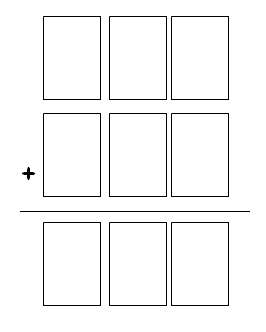
Alternatively, challenge
them to find two two-digit numbers to add together to make 100 or
even two three-digit numbers to make 1000. You have to allow the
100 or 1000 to be written without using any of the digits provided
since they would not have enough zeros to make it!
Years 5 and 6
After a quick warm-up and
demonstration, give each pair a set of digit cards and ask them to
solve one or all of the following digit problems. Allow them to
choose which one to start work on, but allow them to change if they
feel they have found all possible solutions or are getting
frustrated.
What if the total was a
four digit number?
Change any of the
operation signs and explore further. Alternatively, ask the
children to write a set of five questions which use up all the
digits. Can the rest of the class solve these puzzles? You
may also like to look at
Dicey
Operations.
All of these activities
will tell you so much about the children's understanding of number
and their attitude to mathematics. You will be able to see how
flexible they are, whether or not they can explore and persevere
and you will get a good idea of who works well with whom. Then you
have the whole year ahead to investigate and discover mathematics
together!