

Baked Bean Cans


Problem

This challenge is all about cans or tins - the kind in which you might buy baked beans or soup.
Is there a best way to stack cans?
What do different supermarkets do? Can you explain why they might stack cans in that way?
How high can you safely stack the cans?
Investigate the different ways in which cans roll.
Does it make a difference if the can is empty compared with when it is full? How about a partially-filled can?
Getting Started
Next time you go to a supermarket, have a look at the way cans are stacked. Or you could ask an adult to help you search for some pictures on the internet.
It would help to find some cans to stack for yourself. It doesn't matter whether they're unopened or empty and washed out.
Why do supermarkets stack cans?
Student Solutions
We had many ideas sent in showing that there were various ways of commenting on the stacking situation. Some sent in pictures or diagrams. Well done all of you!
Joseph from St Martha's School wrote;
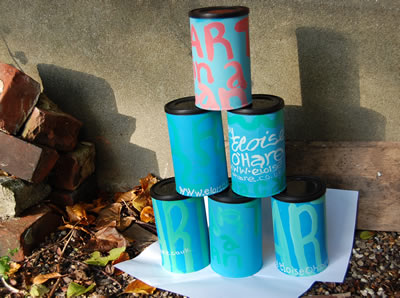
Start off with a big number of cans at the bottom and put on less until you run out of cans.
He also sent in this picture.
Rayan from St. James' School sent in the following;
$1$. The best way to stack cans is to put at least $5$ or $4$ cans.
$2$. The supermarkets stack cans like putting $4$ on the bottom, $3$ on the lower middle, $2$ on the upper middle and $1$ above to separate different cans.
$3$. I might safely stack cans up to $10$.
$4$. If you kick it or turn the tray at an angle or pass it to another person on the ground, then the cans will roll.
$5$. Yes it makes a difference between full and empty because full is heavy and empty is light.
Tom and Jack from Stonehenge School said;
We think the best way to stack cans to its highest limit is the traditional method, the method that people use in fairground stalls, what you do is put say: five cans at the bottom, then four on top, then three and so on so on. This is what we think and may not be true.
Their picture is;

Shamim from Ashcroft Techology Academy wrote;
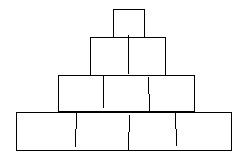
The best way to arrange cans is in a pryamid. Pyramids are the strongest form of support. There are earthquake proof buildings in the shape of a pyramid because the base of the pyramid is big enough to hold the rest of the cans on top. If we were to split a pyramid into squares you can see that for each square above the first line there are two squares below supporting it.
Teachers' Resources
Baked Bean Cans
This challenge is all about cans or tins - the kind in which you might buy baked beans or soup.
Is there a best way to stack cans?
What do different supermarkets do? Can you explain why they might stack cans in that way?
How high can you safely stack the cans?
Investigate the different ways in which cans roll.
Does it make a difference if the can is empty compared with when it is full? How about a partially-filled can?