Copyright © University of Cambridge. All rights reserved.
'Four Teachers Using NRICH' printed from https://nrich.maths.org/
Show menu
Vicki Pike was one of four NRICH Teacher Fellows who worked on embedding NRICH materials into their teaching during the year 2008 - 2009. During the project, Vicki was teaching a maths set, containing 26 children (20 Year 6, 6 Year 5) ranging from level 4C to 5A at the start of the year. In this article, she writes about her
experiences .
Where will I get the time to do this as well as teaching all the other objectives? (and subjects)
Obviously within my group there was less pressure on curriculum coverage as most were competent with Year 6 objectives, or took little teaching time to become competent with them, and there was a clear need for extension which the NRICH activities really helped me fulfil in a motivating way. However, I feel that these activities could be used with any group as they are accessible at many
levels and offer opportunities for those more lateral thinkers who are not necessarily the most numerically able.
Why focus on problem solving?
- It is a life skill;
- It is applicable in other areas and across the curriculum;
- It can engender a sense of achievement and satisfaction; improves self-confidence;
- It can and should be enjoyable;
- It offers opportunities to apply numerical skills;
- Oh, and it's in the SATs papers.
I have previously found students to be stymied by problems expecting more than one possible solution. My class this year instead seemed to find such questions reassuringly straightforward compared to some of the NRICH problems we'd considered.
How could I start using these resources?
I found that initially some children found it quite difficult to tackle any question where the answer was not immediately obvious and they also had little idea about how to organise their solutions. I began by using some of the more closed questions (look for those with one star of challenge usually) as starters or one lesson sessions. For example:
Shape Times Shape (Stage 2 *)
This was great as a starter; everyone could understand what to do and there was some really good discussion generated. It enabled lower ability students to make observations and explain reasoning (especially what happens when you multiply by 0 or 1) It was possible to pose questions like:
Why do you think 7 and 11 are missing? What do we know about those numbers?
and extend thinking.
Up and Down Staircases (Stage 2 *)

We tackled this using multilink for those who wanted to (this became a bit of a problem for those wanting to make the 10 x 10 staircase). This was a problem I put up on the wall and allowed children to add their ideas to it and continue doing so over the week. The excellent interactivity enabled a clear discussion of square numbers and it was also good for a simple demonstration of
algebra/square notation. Children liked having to write clear (but short and easy) solutions for others to read. We focussed quite a lot on how to record ideas and solutions tried. Gradually there was an awareness of the usefulness of tabulating ideas, starting with smaller numbers and working systematically.
As part of my INSET with trainee teachers we considered ways in which these resources could be used and came up with:
a) whole class sessions lasting one or more lessons (these were my personal favourites)
b) extension tasks to be introduced as a whole class and then worked on when other work finished for a period of time. A long-term display could be linked with this, to which children add their solutions as they finish them. I found 'Up and Down Staircases' worked well in this way. There is then a need to have a session considering everyone's ideas and sum things up.
c) Homework tasks for everyone, or to stretch the more able (I found they completed and returned these well but did feel that I didn't always value their work or follow up on it enough. I will plan better for this next year.)
d) Time set aside each month for consideration of the newly published problems and a chance for children to submit solutions and ideas (mine LOVED seeing their ideas appear on the website). Great if you can use a computer suite for this as children can work on the problems away from the computers and then e-mail their ideas. VERY motivating and really makes them think about:
- Is my solution correct?
- Does my solution make sense to someone else?
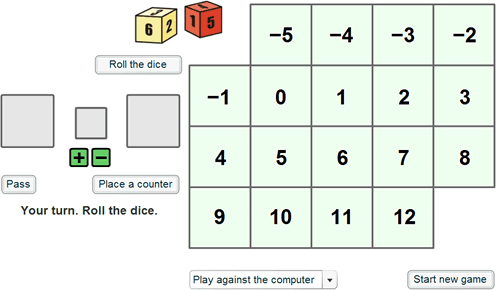
One of the most successful problems I used was called First Connect Three. There are actually two differentiated games available. We played first with me against the class (very motivating) and then in pairs on computers and using dice and gameboards. I had to fight against the urge to tell my pupils to stop
playing but actually they did all get onto tackling the questions related to the game in the end. This was really open ended, some children found it hard to decide what they were being asked to do and we never even got to a very settled solution, but had a lot of fun on the way towards one. I allowed children to choose which one to tackle as one involved subtracting negative numbers, and they
self selected well. In hindsight I would have thought more carefully about how to introduce this concept as some really struggled, but many have retained the ideas raised. There is a nice article on the site that might help others with this. Children found it quite difficult to express their strategies and ideas, except
for the most able who were eventually motivated by the published solution asking for further info and thanking our class for making a start on it (this was a couple of weeks later, and they were still engaged and wanted to write in with their improved ideas).
I have noticed a definite improvement in their attitude to open ended questions; when I started the July 2008 ' Cubes Here and There ' problem, the children were almost immediately engrossed.
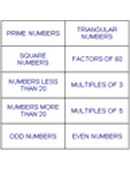
The interactivities are great and often fun - my children enjoyed Venn Diagrams and Carroll Diagrams as they could move the numbers about on screen (even though these were a bit easy for them). However, most of our problem solving went on away from the computer as the resources can be very easily printed
off, and it was often helpful to have an IWB to display the site on. And it's FREE and updated monthly, with children's solutions published and acknowledged.
Hang on a minute, these look really hard! What if I can't solve them?
It can be quite intimidating as a teacher to start a lesson with no idea where the children might take you! I find this quite exhilarating but appreciate that it is by no means everybody's cup of tea. Therefore: don't panic! All problems on the mapping documents, and many others, have a 'Teachers' Notes' section suggesting in a helpful, step by step, manner how a problem might be introduced.
Most problems (except for the newly published ones) have solutions so it is possible to check where you might be heading before you start.
Part of the importance of open ended work like this is for students to consider how mathematical problems may have one solution or many or maybe none! My children have really warmed to this idea from an initial attitude of, in some extreme cases, abject panic. We have particularly enjoyed problems where the whole class contribute ideas over a longer time, such as Tiles on a Patio where children are still adding ideas/contributions a month later.
My school is embracing cross-curricular teaching - does this feed into this? Not directly, but the skills developed by this kind of working could then be employed in a more cross-curricular fashion.
My group worked to develop an outdoor problem-solving maths trail that other classes in the school could use, including researching the cost of playground markings and evaluating each others' questions for clarity. This still needs some work as they tend to favour questions of the 'count how many benches there are and multiply by the number of trees' kind rather than anything investigative
but they are slowly beginning to consider the mathematical merit of what a problem could be asking them to do.
Looking forward
I am very keen to continue the use of NRICH resources. I want to use more and formalise my use of them more regularly for display and homework. I am interested in considering more ways to encourage and structure group work to support the less confident. I have used talking partners a lot this year as it has been a whole school focus, and rotated pairs around but I am interested by the idea
of setting up formal group roles such as facilitator, group leader, reporter etc as I have used this sometimes in other subject areas but not considered really applying them in maths.
Working with others
I would really like to pair up with a teacher of a much less able set and mentor their use of the site and resources and see what happens, as it is hard to answer the charge of this being fine for me with the more able.
I have worked a lot with others during informal discussion/planning time within my department and this meant it has been easy to demonstrate what I have done or how pupils we all knew well had responded. It was also possible to make suggestions of problems they could use.
I have also posted some ideas and suggestion on the TES website primary forum during relevant discussions. I led an INSET session for PGCE trainees where we considered a selection of problems and evaluated our emotional and intellectual response to them and also considered the importance of problem solving skills (see above). I explained the curriculum mapping document and gave everyone time
with a computer to explore the site and identify problems related to their current teaching topics. General feedback was very positive: trainees were unfamiliar with the site and raised questions about time/curriculum coverage/strategies to support less able etc but left feeling positive and with some planning to use examples. More formally, I will lead a whole school INSET for staff as a
reflection of the whole year, how well the experience of being a teacher fellow has worked and to structure how my experiences can be drawn on throughout the school.
[Readers may also be interested in other similar articles about teachers using NRICH]