

Floored


Problem
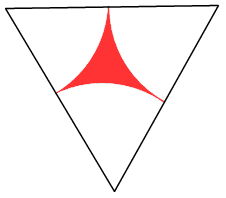
A floor is covered by a tessellation of equilateral triangles, each having three equal arcs inside it. What proportion of the area of the tessellation is shaded?
Student Solutions
Congratulations to Nisha Doshi, Year 9, The Mount School, York for this beautifully explained solution.
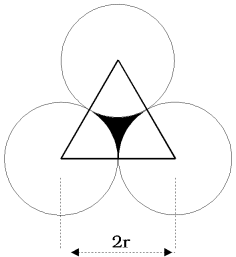
If these triangles are made into a tessellation, they will form regular hexagons with circles overlaid. Each triangle consists of 3 x 1/6 = 1/2 of a circle, plus the shaded area, so to find the area of the shaded section, you can do : (area of triangle - area of 1/2 of a circle)
Using Pythagoras' Theorem the height of the triangle is $\sqrt((2r)^2 - r^2 ) = r\sqrt3$. So the area of the triangle is $r^2\sqrt3$. The area of ${1\over 2}$ a circle is ${1\over 2}\pi r^2$. So the area shaded is $r^2\sqrt3 - {1\over 2}\pi r^2$ and the proportion of the tessellation that is shaded is $$ \frac{r^2\sqrt3 - {1\over 2}\pi r^2}{r^2\sqrt3} = 1 - \frac{\pi}{2\sqrt3} $$
Well done Arwa Jamil, Year 8, the International School Brunei who calculated correctly, to 3 significant figures, that 9.31% of the floor is shaded.