

Children's Mathematical Writing
Allowing pupils to record their mathematical ideas as they wish can open up some interesting thoughts in a teacher's mind.
I was doing an activity rather like I'm 8 but on this occasion we were making twenty. One of the adults in the room made some unencouraging comments about this piece of work that they saw a 7-year old had done:
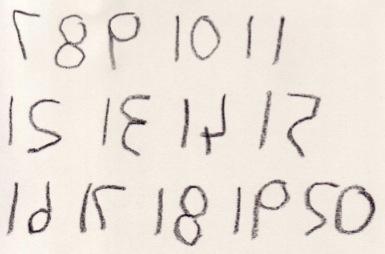
I was intrigued so I asked the young girl to tell me about what she had done. She spoke, as if disturbed that I should need to ask, and said, "Well, YOU said make twenty in any way we like. So here are ..." (she started to count the number of numbers that she had written down) "... fourteen numbers and ... there's the six that I did not write, that makes twenty." There was a pause and then she added, "I've written them this way so that when you put a mirror next to them you can see what the numbers are."
It's so easy and tempting to draw conclusions about what we see, viewing it as a piece of maths that an older and more experienced child might present, therefore judging it to be very poor. It could have been assessed as a piece of work illustrating that the pupil has no idea about writing numbers or of performing a calculation that would give $20$ as an answer.
So, I'm pleading for caution on making assumptions, when looking at a child's representation of the mathematics they have done. We need to consider the child's ability to communicate (and the opportunities we provide for communication), the child's understanding of his or her own mathematics and to bear in mind that this may not necessarily, at this stage, be totally in line with 'school maths'. Children's Mathematics; Making Marks, Making Meaning by Worthington and Carruthers (2006) can help us to broaden our understanding of these issues. (This can be purchased from Abebooks from here.)
- If pupils leave their work - to go to toilet, lunch, sharpen a pencil etc. they'll know where they've got to on return.
- To help the child express his or her OWN thinking.
- To be able to see if - when applicable - he or she is doing unnecessary repeats.
- To give pupils opportunities to see any patterns that may be evolving.
- To get some extra idea of further work they could do - ones in a sequence that they have missed out - this might be applicable, for example, in Red Express Train and Tri.'s .
- To help them get into a system for working further.
- To aid working with a friend, sharing aspects of the work and discussing the progress so far.
- To guide conversation and explanation with classroom adults.
- To lead, later, to explaining to a group or the whole class what they have been doing.
- To lead, much later on, to being able to present some work to an adult, leave it with them and the adult fully understand what has been carried out - even in a test or examination!
I was visiting a classroom and went to a 9-year old boy and this is what I saw:
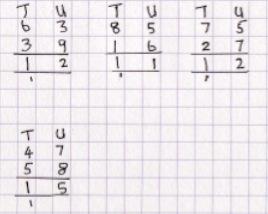
He was just about to start the next one, from the work card from which he was copying his work, when I asked him to tell me how he was doing the calculations. Very confidently he explained the last one saying, "Seven and eight are fifteen so I put down the five and carry the one", (showing me where the little one was). "Four, five, one and five make fifteen." (He pointed to the four and five under the tens, the one he carried and the five that was in his answer for the units.) Now I realised that, considering what he said in isolation, it was quite correct.
I have re-lived this with a number of teachers and they have suggested that the boy had all kinds of problems - lack of understanding of place value, a real need for some counters, not ready for these kinds of sums yet etc.
Here is a PDF version of this article.