

Lengthy Journeys

 1 out of 3
Investigate the different distances of these car journeys and find out how long they take.
Problem
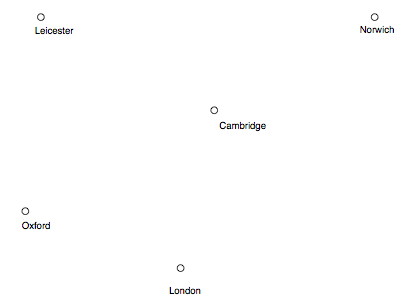
We could be making some car journeys between these towns and so here is a chart giving us some information about distances and times.
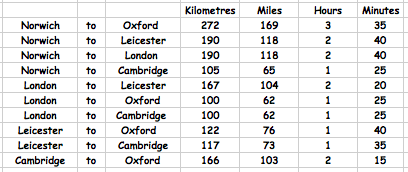
These numbers show us direct routes. But now, suppose we go on journeys involving three or four cities.
For example, we could go from Norwich to Oxford but go through Cambridge on the way.
Or, we could go from London to Leicester but go through Oxford on the way.
What other journeys involving three or four cities can you find?
When you have some of these answer these questions:
1. What is the total distance of your journey in kilometres?
2. How many minutes long is your journey?
3. How much longer (in terms of time) is the journey when passing through another city or other cities along the way compared with the direct journey between the starting city and the final destination?
Now you could try and find the longest route (in terms of distance) for visiting all five cities.(We might decide that we will only visit each city once.)
What about the shortest route for visiting all five cities?
How much longer does it take to travel the longest route compared with the shortest route?
Getting Started
How will you record your different journeys?
Have you thought of drawing a sketch of the map yourself and drawing routes in different colours? Or perhaps you will make a list?
What information will you need to work out the distances and the time taken for each journey?
Student Solutions
We often find that not many solutions are sent in when there is a very large number of possibilities and it's up to you to choose. However we'd like to hear about any work that you do in relation to the problems set.
Teachers, if the pupils' work does not lend itself to being sent in, it would still be good just to hear what went on when a problem was being tackled by your pupils.
Here are the answers that we got that showed clearly what some of you did .
Matthew
I began at Cambridge and I'm going to Norwich and I go though Oxford and Leicester. How long will it take and how long is it to travel?
distance: 166km + 122km + 190km = 478km
time:135min + 100min + 160min = 395min
Tom
Leicster to London via Norwich and Cambridge
Leicster to Norwich-190 km 2h 40m
Norwich to Cambridge-105km 1h 25m
Cambridge to London-100km 1h 25m
total distance=395km total time=5h 30m
Teachers' Resources
Using NRICH Tasks Richly describes ways in which teachers and learners can work with NRICH tasks in the classroom.
Why do this problem?
Possible approach
Key questions
Possible extension
Possible support
In addition to talking more with those children who are finding the task challenging, it might be appropriate to simplify the problem by fixing the starting and finishing cities. It would also be useful to have calculators available.