

Ishango Bone


Problem
In 1960, a strange bone cutting tool was discovered during the excavation of a prehistoric site in Zaire.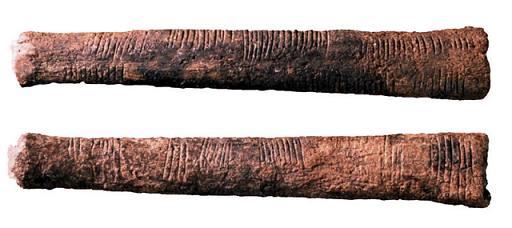
On the bone tool are a series of markings arranged in regular patterns. They appear to exhibit a lot of possible mathematical structure. There are three rows of markings; on each row the markings are grouped into clusters as follows:
Row A: $19, 17, 13, 11$
Row B: $7, [5, 5, 1, 9], 8, 4, [6, 3]$ (we are not sure how the scratches in the brackets were grouped)
Row C: $9, 19, 21, 11$
(In row B, the groupings of some of the scratches is not very clear: the $[5, 5, 1, 9]$ part might also be $[10, 10]$ or $[10, 1, 9]$ or $[5, 5, 10]$. Similarly, the $[6, 3]$ scratchings might be grouped into $[9]$ .)
Investigate these numbers and their properties.
Do you think that they are just random, or can you see any patterns?
How do you think that the scratchings should be grouped?
Can you create a hypothesis as to the meaning of the scratches or why they might have been made?
Why are you making a hypothesis and not a proof?
Would it ever be possible to be certain of the meanings of the scratches?
Imagine that you find another similar bone which was created according to your rules. What different patterns of scratches could it exhibit?
This bone is around 20,000 years old and is one of the oldest known artefacts exhibiting mathematical structure. Although there are many theories about the meaning of the scratches nobody knows for sure what their purpose is. Perhaps if another similar artefact were found in reality then evidence for the different sorts of hypotheses would grow. It might even be that you will come up with a really clear explanation of all of the scratches which nobody has yet thought about!
You might like to read about this artefact on the wikipedia, from which the images were taken.
Another interesting mathematical artefact, which has a more convinving explanation, is analysed in the problem Babylon Numbers.
Getting Started
Student Solutions
We received many interesting ideas concerning the Ishango bone. Thanks to you all for sending in your comments.
We were particularly pleased to hear from Huylebrouck at the Department of Archeology in Brussels, who gave us these fact concerning the bone:
A second Ishango rod was found indeed.
The Ishango rods are not "believed" to be 22000 years old. They are: they were dated through Carbon 14.
Alex and Theo said
We looked at Row C and found that $9 + 10=19$ and that $21 - 10 = 11$, the top line is all prime numbers so the bone could be a mathematical aid in the shape of a pen so people could use it as they worked.
Ben and Joshua from Lancaster Royal Grammar School noted the mathematical fact that
Row c has a pattern of not prime, prime, not prime, prime and the non primes are multiples of three.
Shrish, also from Lancaster Royal Grammar School gave a very interesting analysis. We had not previously seen the concept of adding the numbers in vertical columns(well done for thinking of this Shrish!)
Row A: 19, 17, 13, 11
Row B: 7, [5, 5, 1, 9], 8, 4, [6, 3]
Row C: 9, 19, 21, 11
If we add the rows vertically, with the extra number in middle row getting added on at the end we get
$$19+7+9=35 \quad17+20+19=56 \quad 13+8+21=42 \quad 11+4+11+9=35$$
Since 35 is the common factor, we will divide the other numbers by this:
$$\frac{42}{35}=1.2 \quad \frac{56}{35}=1.6
$$
These answers add up to make 2.8. All the numbers on all the rows add up to 168. If we divide this by 2.8, we get 60 which is the sum of the first and third rows. Now instead of adding 1.2 and 1.6, we subtract the first first from the latter to get 0.4. If we times 168 by 0.4 we get 67.2. Now take 48 from 67.2 (48 is the sum of the middle row). We get 19.2. 19.2 to 48 is the same proportion as
67.2 to 168.
$$
\frac{19.2}{48} =\frac{67.2}{168} = \frac{2}{5}
$$
I think this shows there are definitive patterns and the numbers are not random. [we agree!]
Some of you suggested thesethe uses for the bone
- [Daniel from Tudhoe Grange] The markings are there for the amount of kills that the person (if it was a person) had killed, such as the amount of dinosaurs he killed and they are spread out for every month.
- [Ben and Joshua from Lancaster Royal Grammar School] How many baboons killed each season and were put onto a chart they killed up to sixty per season
- [Mr Garrod and 8q2 from The Sweyne Park School] It's bingo! Row A and C are set out so that they are 'fair' (each 4 numbers with a mean of 15). Small bits of grass, stone or wood could be cast onto the middle row to select numbers. if they add up to any of your 4 numbers you cross it out. first to cross out all 4 numbers wins! The existence of the 19 in both rows A & B suggests the possibility of drawing a game...
We loved the idea that the bone was used as a game of bingo.
Teachers' Resources
Using NRICH Tasks Richly describes ways in which teachers and learners can work with NRICH tasks in the classroom.