

Funnel

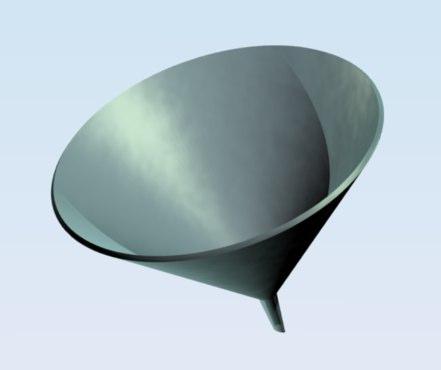
A plastic funnel is used to pour liquids through narrow apertures. What shape funnel would use the least amount of plastic to manufacture for any specific volume ?
Problem
A plastic funnel is used to pour liquids through narrow apertures. Have you ever tried pouring a drink from a glass back into a bottle ? If we imagine a funnel as a complete cone (why isn't it?), what shape cone would use the least amount of plastic to manufacture a funnel containing a set volume? You don't need a specified volume, but it may help to ask what proportion cone would hold a litre of liquid using the least amount of plastic. See the Hint for more help. | Image
|
Getting Started
As an example of how you might begin, take one litre as the volume.
How many cubic centimetres is that ?
And how long would the 'slope length' be in each case ?
How do you calculate the curved surface area using those things ?
Can you refine your answer with more precise values tried for the radius length ?
Could a spreadsheet help with the repeated calculation ?
Student Solutions
You may have heard the term 'Calculus', it's a big idea in mathematics and so powerful that I find it hard to imagine mathematics without it. It's main technique, differentiation, makes problems like this fairly easy - with a little care over the algebra. So if you are thinking about continuing with mathematics beyond Stage 4, learning about differentiation would be one of the big benefits that await you.
But differentiation is not really Stage 4 mathematics, though very close, so we don't use it in solutions because that would be unfair to students who haven't seen the idea before, it would be like suddenly changing into a language you haven't had a chance to learn yet.
If that's got you interested why not take a look at Vicky Neale's article: Introduction to Differentiation
And thank-you to David and Berny from Gordonstoun and to Naren from Loughborough Grammar School who sent in great solutions using that technique .
In fact the use of differentiation did more than get an answer. It found the result that the cone needed to have its height 1.41 times bigger than its radius, like the Stage 4 result below, but found it in this more interesting form.

And the value of that is that it suggests a new direction to pursue with this problem : it seems so neat.
Why the square root of 2 ? Is there a connection with the diagonal of a square ? Or is it something else?
That's maybe a little bit on from us at Stage 4 so here's a way to solve a problem like this using Stage 4 mathematics. It's really 'trial and improvement' but using a spreadsheet to make the calculation more straightforward.
We are going to use :
- the radius, which we'll adjust to get nearer and nearer to the answer,
- the height, which will be determined by our choice of radius, so that we get the chosen target volume
- the slant length, which we'll find using r and h and Pythagoras,
- and the surface area, for which there's a great little formula.
The volume of a cone is one third the volume of a cylinder with the same base and height.

If we took the target volume to be 1 litre, 1000 ml, then the formula that connects h and r is

The slant length (s), using Pythagoras, is

And the surface area of a cone is

plus the base if you need it - here we don't.
Incidentally, if you don't know where that surface area formula comes from it may be good to take a moment to look at that. Flatten the curved surface out to get a sector (how do you know it's a sector ?). The radius will be the cone's slant length, so you can calculate the area of the whole circle. To know the proportion that the sector is of that circle compare the sector arc, which is the cone's base circumference, with the circumference of this new circle, radius s.
Can you see what each column does ? Click on a cell and check the formula.
- The first column has increasing radius values which you can control.
- The next column calculates the height, because we knew the volume was 1000 ml
- The radius and height are then used to calculate the slant length.
- And the final column uses the radius and the slant length to calculate the surface area, which we want to be as small as possible
There's even a graph so you can have some sense for how surface area varies as the radius value ranges across your chosen interval.
Teachers' Resources
See the Hint section for detailed support for students, but one of the main aims of this problem is to use a spreadsheet to open up a problem that is otherwise rather tedious to pursue by calculation. Students may need help thinking through the calculation required and the spreadsheet commands (formulae) necessary to achieve that. This is a challenging problem.
The relationship between surface area and volume enclosed is an important theme for able students at Stage 4 and using IT effectively should be part of a good student's repertoire of problem solving approaches.
With able students it is good to draw out that the ratio between the volume and the surface area will change with scale, but the optimum shape for the cone will not.
Perhaps reasoning in terms of units : measurements in a different unit of length would change all the numbers (how ?) but not the height-radius ratio (or cone angle) where the surface area takes its minimum value.