

Quad in Quad


Join the midpoints of a quadrilateral to get a new quadrilateral. What is special about it?
Problem
Draw any convex quadrilateral and find the midpoints of the four edges.
Join the midpoints to form a new quadrilateral.
A convex quadrilateral is one where all of the angles are less than $180^{\circ}$. Alternatively you can use the definition that both diagonals lie inside the shape.
Try it a few times starting with different convex quadrilaterals.
What do you notice about the new quadrilaterals formed by joining the midpoints?
Does this always happen?
Can you find a counter-example?
Can you make a conjecture?
You may wish to use the GeoGebra interactivity to explore what happens as you move points A, B, C and D.
Can you prove your conjecture?
Is the area of PQRS always the same fraction of the area of ABCD?
Can you explain why?
Once you have had a think about this, you might like to take a look at these two different proofs which have been scrambled up. Can you rearrange them back into their original order?


Do these results still hold if ABCD is a concave quadrilateral?
A concave quadrilateral is one where one angle is greater than $180^{\circ}$, for example you could draw an "arrowhead" shape.
If you can find a proof which is different to the ones in our proof sorters, then please do let us know by submitting it as a solution.
Getting Started
What shape do you think is being made by joining the midpoints of the sides? Which properties of the shape do we have to establish to prove that it is this partilcar type of shape|?
In the diagram below, the diagonals $AC$ and $BD$ of the original shape have been drawn in.

What can you say about the lines $AC$ and $PS$?
What about lines $AC$ and $QR$?
Can you prove you conjecture?
Student Solutions
Clara from Herlufsholm School in Denmark sent in some observations. You might find it helpful to sketch or visualise the labelled quadrilateral from the problem as you read Clara's observations:
I noticed that the quadrilaterals formed by joining the midpoints always has two pairs of parallel sides. This means that the shape formed is always a square, rectangle or parallelogram. There didn't seem to be any counter-examples to this. This is because when you move one point (For example C) and keep all the other points the same, two points of the new shape move (R and S). This means that the top and bottom edges do not change angle (RS and QP). The other two sides however move but with the same amount and therefore also stay parallel.
PQRS always has half of the area of ABCD. One way to show that this is always true could be to draw a line through the points SQ and RP as in the picture attached. When you take a quarter of the whole image there is another quadrilateral with a line through the middle (as shown in the picture underneath figure 1).

If figure ABCD is concave, the ratio of the area of ABCD and PQRS is still 2:1.
Clara's observations and predictions are correct, but this way of showing that PQRS has half the area of ABCD won't always work. For example, in Clara's picture 3, the triangles in the pieces are not the same size. This is shown below. In the second image, the yellow triangle has been rotated to show that it has a smaller area than the red triangle.


Samvit from Mason Middle School in the USA sent this rigorous proof:
The new quadrilateral will always be a parallelogram.

For this proof, CASTC means Corresponding Angles of Similar Triangles are Congruent, which is part of the definition of a similar triangle (like CPCTC).
Take this arbitrary image of a quadrilateral, where
E is the midpoint of segment AB.
F is the midpoint of segment BC.
G is the midpoint of segment CD.
H is the midpoint of segment DA.
Two column proof:
| Statement | Reason |
|---|---|
| E is the midpoint of segment AB | Given |
| segment AE is congruent to segment EB | Definition of a midpoint |
| AE = EB | Definition of congruence |
| AE + EB = AB | segment addition postulate |
| EB + EB = AB | Substitution |
| 2(EB) = AB | Simplify |
| angle EBF is congruent to angle ABC | Reflexive property |
| F is the midpoint of BC | Given |
| segment FC is congruent to segment BF | Definition of a midpoint |
| FC = BF | Definition of congruence |
| FC + BF = BC | Segment addition postulate |
| BF + BF = BC | Substitution |
| 2(BF) = BC | Simplify |
| triangle EBF is similar to triangle ABC | SAS similarity |
| angle CAB is congruent to angle FEB | CASTC |
| Segment AC is parallel to segment EF | Converse of Corresponding Angles |
| G is the midpoint of segment CD | Given |
| Segment GC is congruent to segment GD | Definition of a midpoint |
| GC = GD | Definition of congruence |
| GC + GD = CD | segment addition postulate |
| GD + GD = CD | Substitution |
| 2(GD) = CD | Simplify |
| angle CDA is congruent to angle GDH | Reflexive property |
| H is the midpoint of DA | Given |
| segment AH is congruent to segment DH | Definition of a midpoint |
| AH = DH | Definition of congruence |
| AH + DH = DA | Segment addition postulate |
| DH + DH = DA | Substitution |
| 2(DH) = DA | Simplify |
| triangle CDA is similar to triangle GDH | SAS similarity |
| angle DAC is congruent to angle DHG | CASTC |
| Segment AC is parallel to segment HG | Converse of Corresponding Angles |
| Segment EF is parallel to segment HG | Transitive property of parallel lines |
| AE + EB = AB | Segment Addition postulate |
| AE + AE = AB | substitution |
| 2(AE) = AB | Simplify |
| Angle HAE is congruent to angle DAB | Reflexive property |
| AH + DH = DA | Segment Addition postulate |
| AH + AH = DA | Substitution |
| 2(AH) = DA | Simplify |
| Triangle HAE is similar to triangle DAB | SAS similarity |
| Angle AHE is congruent to angle ADB | CASTC |
| Segment DB is parallel to segment HE | Converse of Corresponding Angles |
| FC + BF = BC | Segment Addition Postulate |
| FC + FC = BC | Substitution |
| 2(FC) = BC | Simplify |
| Angle FCG is congruent to angle BCD | Reflexive |
| GC + GD = CD | Segment Addition Postulate |
| GC + GC = CD | Substitution |
| 2(GC) = CD | Simplify |
| Triangle FCG is similar to triangle BCD | SAS Similarity |
| Angle CGF is congruent to angle CDB | CASTC |
| Segment DB is parallel to segment GF | Converse of Corresponding Angles |
| Segment HE is parallel to segment GF | Transitive property of parallel lines |
| EFGH is a parallelogram | Definition of a parallelogram (opposite sides are parallel) |
Nayanika from the Tiffin Girls' School in the UK proved that the area of the small quadrilateral is half the area of the large quadrilateral. Nayanika's proof uses the fact that the small quadrilateral is a parallelogram.
Vid from High School Srednja Å¡ola ÄŒrnomelj in Slovenia used a shorter method to prove that the shape is a parallelogram, and also proved the result about the areas. Click here to see Vid's work.
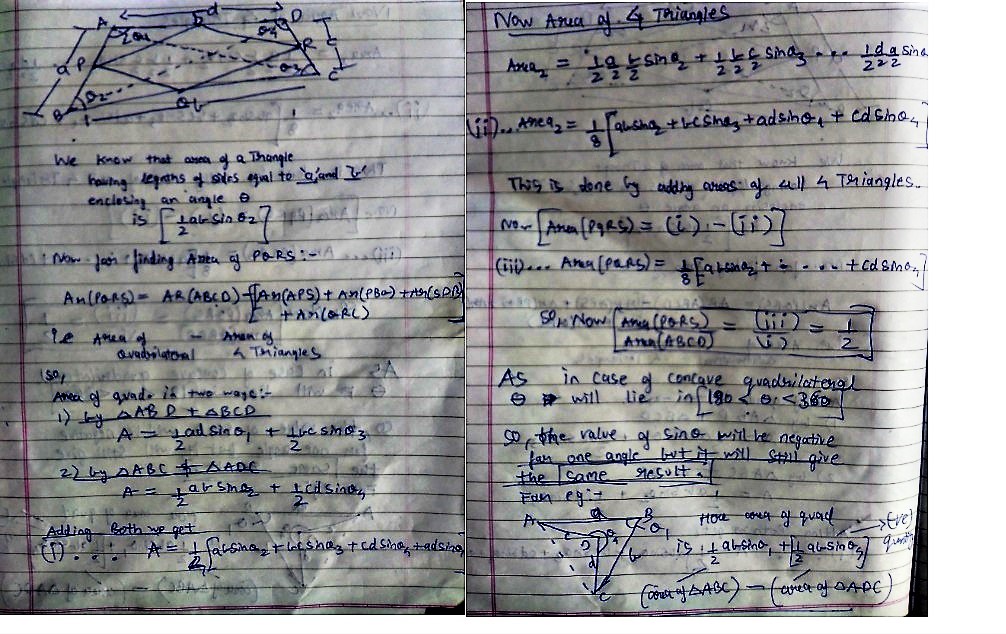
Marmik from India proved that the area of PQRS is half of the area of ABCD using the formula for the area of a triangle, $\frac12ab\sin{C}$. Click here to see Marmik's work.
Ana used coordinate geometry to derive the two results. Click here to see Ana's work.
Teachers' Resources
Using NRICH Tasks Richly describes ways in which teachers and learners can work with NRICH tasks in the classroom.
Why do this problem?
This problem introduces students to a surprising result which holds true for all quadrilaterals, although in the problem we invite them to explore convex quadrilaterals first. The GeoGebra interactivity provides a hook to engage students, and we hope the result will be intriguing to students, encouraging their curiosity and giving them a desire to persevere until they have proved the result.
Possible approach
This problem featured in an NRICH Secondary webinar in March 2022.
These printable cards for sorting may be useful for proving the results about the shape and area of PQRS: Shape of PQRS, Area of PQRS
You may wish to begin by inviting students to draw their own quadrilaterals on dotty paper, which you can print off from our Printable Resources page. Once they have generated a few examples, invite them to explain anything they have noticed. This is a really good opportunity for discussion about the examples they chose - did their original quadrilaterals have any particular symmetry properties that might have caused the results they are finding? Can they find an example that doesn't work?
At this point, you might like to encourage students to explore using dynamic geometry, either by using the interactivity in the problem, the interactivity created by Alison Kiddle, or constructing their own using software such as GeoGebra, which is free to use.
Diagrams such as this one might be useful for helping students to construct a proof:
Give students some time to have a go at the problem. While they are working, circulate and see the methods they are trying. As well as considering the shape formed, students could also calculate the area of the original quadrilateral and the new one formed by the midpoints, and look for a relationship.
Once students have had some time to try working on a proof, bring the class together again and acknowledge that the proofs may not be immediately obvious.
"I've been given two different proofs (one for the shape and one for the area properties), but unfortunately both have been jumbled up. Can you put the statements in the right order to build a logical argument?"
Hand out envelopes with the statements for the Shape proof (or direct students to the interactive proof sorter for shape) and the Area proof (or direct students to the interactive proof sorter for area)
"With your partner, make sense of each step and put the cards in the right order.
Once you've completed the task, can you recreate the method for your partner without looking at the cards?"
The interactive proof sorters can be used as an alternative to the printable cards, or for students to check their suggested arrangements of the cards.
Key questions
What is special about the new quadrilateral formed by joining the midpoints?
Does it always happen?
Does it help to draw in the diagonals?
Are there any similar shapes in your picture?
Does that help you to work out the relationship between the areas?
Possible support
Students could start by exploring what happens when you join the midpoints of a triangle or could explore Triangle midpoints.
Possible extension
What happens if you start with a concave quadrilateral?