

Shaping the Universe III - To Infinity and Beyond
This article follows on from Shaping the Universe I - Planet Earth and Shaping the Universe II - The Solar System .
Previous articles have looked at the shapes of the earth and the solar system. This final installment looks at what is beyond the tiny part of the universe we live in and what exciting shapes can be found there. All this is fairly recent astronomy, because for thousands of years nobody knew that there was anything beyond the planets and the stars that we can see. The stars were thought to be all fixed into a giant sphere, like a canvas that acts as a backdrop for everything else. Few people dared to think about what was beyond that sphere, except perhaps heaven and hell.
Nowadays we know that our sun is just one of many billions of other stars that make up our galaxy - the Milky Way. Sometimes on a very clear and dark night you can see the Milky Way as a faint band of clustered stars across the sky. The reason we can see our own galaxy from inside it is because of its shape. Like many other galaxies in the universe, our galaxy is shaped like a spiral. Because we are located in one of the spiral arms, we can see the rest of the galaxy sideways on. It's a bit like being an ant, and sitting on one of the spokes of a bicycle wheel. We can still see the rest of the wheel, but it just looks like a big line across the sky because it is flat in the direction that we're looking.
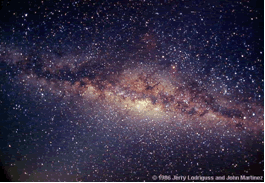
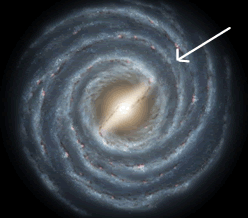
Galaxies come in ellipses, various types of spiral and other amazing shapes too. There are lots of amazing pictures of galaxies taken using powerful telescopes. Check out some more astrophotography at http://www.astropix.com
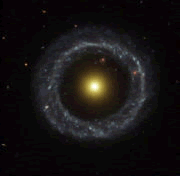
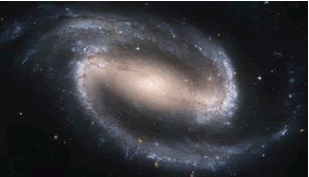
Unlike the shape of the earth and the structure of the solar system, there is no way that we could have known anything at all about galaxies without being able to observe them directly. Some of them can just about be seen with the naked eye or a simple telescope, but most galaxies can only be seen with the biggest telescopes on earth, or the Hubble space telescope which is in orbit around the earth. Using the data from these telescopes, astronomers and astrophysicists use some very clever mathematics to work out how big they are and what makes them the shape they are.
But what do you think is beyond all the galaxies that we can see with our most powerful telescopes? Does the universe as a whole have a shape or is it infinite? That is a question that we are still trying to answer, and one that requires a huge amount of really clever mathematics!