Copyright © University of Cambridge. All rights reserved.
'Lucky Numbers' printed from https://nrich.maths.org/
Show menu
Numbers have always been important, but throughout the ages some numbers have been considered more special than others because of what they signify to different people or civilisations. Sometimes the reasons for a number being 'lucky' or 'special' are based on its mathematical properties, for example see Pi, a Very Special Number and Can You Find a Perfect Number?
Sometimes a number is thought of as lucky because it happens to relate to something else that people think is important. Number 8 is lucky in Chinese culture because the Chinese word for "eight" sounds like the word for "wealth". Some people choose their lucky number because it is the shirt number of their favourite sports player. There are many different ways in which a number can be special. Do you have a lucky number? Why is it special to you?
Two of my favourite numbers are 5 and 7, because they crop up all over the place in nature, history, literature, films and even pop groups! They are both prime numbers too, which makes them even more special.
Fabulous 5
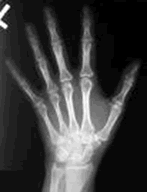
Five is an interesting number because it occurs a lot in nature. Humans have five senses (sight, smell, taste, touch and hearing) and five fingers on each hand. There are some fascinating creatures like starfish that have five-fold symmetry, that means you can rotate them five times and they will still look the same:
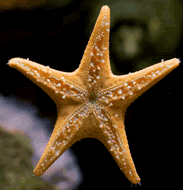
Starfish picture by Tom Trinko
.
The Ancient Greeks believed that everything in the universe was made of five elements:earth, water, fire, air and quintessence which was supposed to be what the heavens were made of. Five is also the number of Platonic Solids that are possible. These are the only 3-dimensional shapes that are completely regular, which means that all their faces are the same size and all their edges are the
same length. Find out more about the Platonic solids, and how to make them here .
Super 7
Seven is another fascinating number. There were seven wonders of the ancient world, amazing man-made structures of which only one survives today - the Great Pyramid of Giza in Egypt. The city of Rome was built on seven hills, as were several other cities including Moscow in Russia, Jerusalem in Israel and Sheffield in the UK.
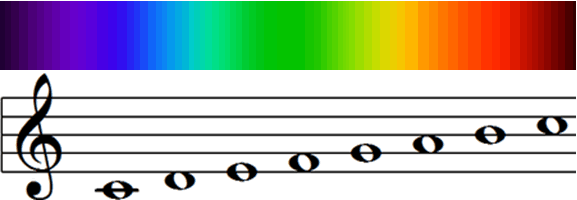
In music there are seven different notes in a harmonic octave (the top note is the same as the bottom one but an octave higher). There are also seven traditional colours of the rainbow. This is no coincidence, in fact it was Isaac Newton who decided that the rainbow should be split into seven colours to match the musical scale:
"And possibly colour may be distinguished into its principle degrees, Red, Orange, Green, Blew, Indigo,and deep Violet on the same ground, that sound within an eighth is graduated into tones."
So you see, spotting numerical connections between things has been a popular activity for centuries. There are actually an infinite number of different colours, but seven is easier to remember.
Now it's your turn!
See how many things you can think of that correspond to your favourite number. If you picked one of the numbers above, try to think of some more things that aren't mentioned here. For example, there are 5 players in a basketball team.... what else can you think of? Next try starting from one and counting upwards. For each number, think of a reason why it is special. How far can you get before you find a number that isn't special? Here are some ideas we thought of, but can you think of different reasons why each of these numbers is special? Try to vary it a bit so that you don't just have your top 20 football players or something like that.
1 is the only number that is the square of itself
2 is the only even prime number
3 is the number of books in a trilogy, like Lord of the Rings
4 is the number of musicians in a string quartet
5 is the number of 'pillars' in the Islamic religion
6 is the number of faces on standard dice
7 is the number of days of the week
8 is the luckiest number in Chinese culture
And so on.... Give it a try and see how far you get. You could even try setting some maths problems for your friends using clues instead of numbers. The possibilities are endless!
References
Penelope Gouk, "The Harmonic Roots of Newtonian Science," in Let Newton Be! ed. John Fauvel et al. Oxford: Oxford University Press, 1988, pp. 101-126. Quotation from p.118.