

It's a Tie


Problem
One Friday morning, Kaia said, "Do you like that tie? You usually wear it at least twice a week."
"I do not," replied her father, "I have eight ties and I only work five days a week. I certainly don't wear any tie more than once a week."
"You have worn that tie twice a week in at least five of the ten weeks you have been taking me to school," Kaia insisted.
"Impossible! Prove it!" challenged her father.
Do you think Kaia or her father was right? Why?
That weekend Kaia did an experiment. She made the following drawings of his ties and created the chart shown below.
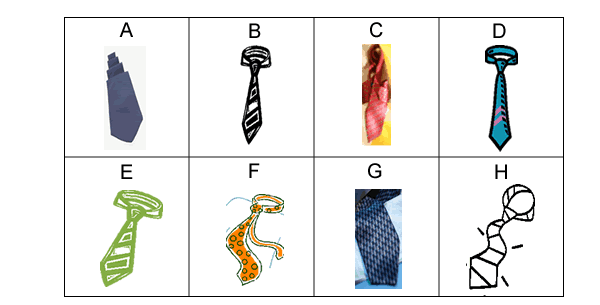
| Week no. | Monday | Tuesday | Wednesday | Thursday | Friday |
| 1 | |||||
| 2 | |||||
| 3 | |||||
| 4 | |||||
| 5 | |||||
| 6 | |||||
| 7 | |||||
| 8 | |||||
| 9 | |||||
| 10 | |||||
| 11 | |||||
| 12 | |||||
| 13 | |||||
| 14 | |||||
| 15 | |||||
| 16 | |||||
| 17 | |||||
| 18 | |||||
| 19 | |||||
| 20 |
How might Kaia use the drawings and chart to prove her father wrong?
Try doing an experiment yourself to find out which ties might be chosen.
What did the result of your experiment show?
Getting Started
Why not create your own experiment? You could draw and cut out ties (or print off this sheet) and perhaps put them in a bag to be picked out.
Maybe you could create a simulation on the computer?
It might be a good idea to work with some friends in different groups so that you have more results to look at.
Look at the results of your experiment. How many times did you pull out the same tie in a week?
How does this compare with your friends' experiments?
Student Solutions
Jannis from Northcross Intermediate said:
"I think Kaia was right. The ties come out of the closet randomly. We know each tie has 1 eighth of a chance to be pulled out, so it's quite likely that the father will not wear 1 tie twice in the week. But it's random so there is a chance of him wearing a tie twice in the week."
Making the point that they're probabilities so you can't be sure.
Matthew and James from Stradbroke Primary did an experiment, and found that they picked the same tie twice in 9 out of 10 weeks. Ege and Onur from FMV Ozel Erenkoy Isik Primary School, Turkey, also did experiments, and you can find their results here and here .
Some people have tried to calculate the probability of picking the same tie twice, but none correctly yet. Here is what happened when we tried the experiment:


Teachers' Resources
It's a Tie
Kaia's father always wore a white shirt and coloured tie for work. He didn't like deciding which tie to wear so he would put his hand in the drawer and wear the first tie that he pulled out. Each evening the tie would go back in the drawer.One Friday morning, Kaia said, "Do you like that tie? You usually wear it at least twice a week."
"I do not," replied her father, "I have eight ties and I only work five days a week. I certainly don't wear any tie more than once a week."
"You have worn that tie twice a week in at least five of the ten weeks you have been taking me to school," Kaia insisted.
"Impossible! Prove it!" challenged her father.
Do you think Kaia or her father was right? Why?
That weekend Kaia did an experiment. She made the following drawings of his ties and created the chart shown below.
| Week no. | Monday | Tuesday | Wednesday | Thursday | Friday |
| 1 | |||||
| 2 | |||||
| 3 | |||||
| 4 | |||||
| 5 | |||||
| 6 | |||||
| 7 | |||||
| 8 | |||||
| 9 | |||||
| 10 | |||||
| 11 | |||||
| 12 | |||||
| 13 | |||||
| 14 | |||||
| 15 | |||||
| 16 | |||||
| 17 | |||||
| 18 | |||||
| 19 | |||||
| 20 |
How might Kaia use the drawings and chart to prove her father wrong?
Try doing an experiment yourself to find out which ties might be chosen.
What did the result of your experiment show?