

The Cantor Set

Take a line segment of length 1. Remove the middle third. Remove the middle thirds of what you have left. Repeat infinitely many times, and you have the Cantor Set. Can you picture it?
Problem
Take a line segment of length 1. We'll call it $C_1$.
Now remove the middle third. Call what's left $C_2$.
Now remove the middle third of each line segment in $C_2$. Call what's left $C_3$.
We can keep doing this, at each stage removing the middle third of each of the line segments in $C_n$ to form $C_{n+1}$.
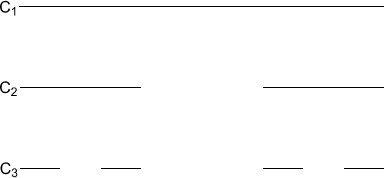
Draw pictures of $C_4$ and $C_5$.
If we suppose that the end points of $C_1$ are 0 and 1, then we can mark on the end points of the line segments for the later $C_n$ too. For example, $C_2$ has end points $0$, $\frac{1}{3}$, $\frac{2}{3}$ and $1$ as shown below.
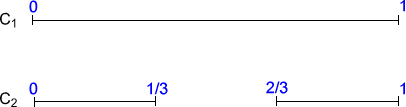
Draw $C_3$ and label the end points, and label the end points on your pictures of $C_4$ and $C_5$.
We can keep removing middle thirds infinitely many times. The set of points left having done it infinitely many times is called the Cantor set.
Which of the following points are in the Cantor set?
$\frac{1}{3}$, $\frac{4}{9}$, $\frac{3}{81}$, $\frac{4}{81}$.
Explain how you decided which belong and which don't.
See also the problem Smaller and Smaller.
Getting Started
Will an end point of one of the line segments ever be removed when going from one stage to the next?
Student Solutions
Liam from Wilbarston School sent us this well-explained solution:
Teachers' Resources
This is the first of two problems; the second problem is How Long is the Cantor Set? . We have published these problems as they provide a good opportunity for pupils to practise using fractions, and also to meet the idea of infinity.
Mathematicians are interested in the Cantor set because it is a good example of an object whose existence is not at first clear.
If you aren't familiar with the idea of countability, then you may be interested in the article All about Infinity. For now, we shall be rather vague and only try to give an indication of the ideas involved, as making them rigorous would take rather more time. Roughly speaking, an infinite set is uncountable if its size is a large infinity.
It is not too hard to see that the Cantor set consists of precisely those numbers between $0$ and $1$ that contain only $0$s and $2$s (no $1$s) in their ternary expansion (like a decimal expansion, but in base $3$). There is a slight technical detail here, because some numbers may be written in two ways: a number that only has$0$s and $2$s apart from a single $1$ at the end may be written using only $0$s and $2$s. For example, $0.21$ (remember that this is in base $3$!) may also be written as $0.20\dot{2}$. (This is precisely analogous to the fact that, in base $10$, $1$ is the same as $0.\dot{9}$.)
From this, it is possible to use the same diagonal argument as is used for real numbers to show that the Cantor set is uncountable. That is, it contains infinitely many points, and the infinity is really large.
Mathematicians have developed a more formal and rigorous version of the idea of length, called Lebesgue measure. The Lebesgue measure of a line is the same as its usual length, but it is also possible to find the Lebesgue measure of other sets. For example, it is possible to find the Lebesgue measure of the set of rational numbers: amazingly, it has Lebesgue measure $0$! However, there are only countably many rational numbers, so in some sense there aren't very many of them, and we perhaps shouldn't be surprised that they don't take up any space.
Having introduced this notion of Lebesgue measure, a natural question is "Is there an uncountable set of Lebesgue measure $0$?". That is, is there an enormously large set that still somehow contrives to take up no space? The answer? Yes, there is: the Cantor set is such a set. (This is the object mentioned earlier whose existence is of interest to mathematicians.)
See How Many Elements Are There in the Cantor Set? for a proof of the uncountability of the Cantor set.