Links to the University of Cambridge website
 Links to the NRICH website Home page

Links to the NRICH website Home page
Nurturing young mathematicians: teacher webinars
30 April (Primary), 1 May (Secondary)
30 April (Primary), 1 May (Secondary)
Little Man
Age 5 to 7
Challenge Level 

Little Man
This problem has been inspired by "The Man", a story by Raymond Briggs, which you might like to read.The Man is much smaller than you and me.
Here is a picture of him standing next to a mug.
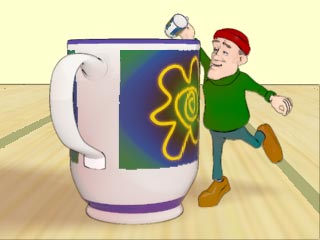
Can you estimate how tall he is?
Can you think of something that you have at school or home that is approximately twice as tall as the Man?
What about something that is about half as tall as the Man?
How tall do you think the Man's mug might be?
Can you estimate how many "Man mugs" of tea might fill one of our mugs?
Why do this problem?
This problem offers a novel context in which to think about relative size, and gives children chances to estimate quantities. The fictional nature of the situation might draw learners in and make them curious to investigate further.
Possible approach
It might be appropriate to read the book "The Man" (by Raymond Briggs) with the class prior to working on this task.
It would be worth having a range of measuring equipment to hand, including access to a water tray, bucket or large bowl along with a variety of everyday items such as spoons, bottles, cups and jugs.
As you pose each question, give the class time to consider their estimations and invite learners to explain how they arrived at them.
You could then ask how we might go about checking whether their estimates are realistic. At this point, try to provide the equipment that children request and stand back, rather than imposing your own method. The more practical experience that learners have with measuring, the better their sense of relative size. Exploring length/height/capacity/volume in practical contexts will give children 'reference points' to draw on when estimating.
You could facilitate a discussion about which methods for estimating gave answers that were closest to measured values, and why that might be.
You could then ask how we might go about checking whether their estimates are realistic. At this point, try to provide the equipment that children request and stand back, rather than imposing your own method. The more practical experience that learners have with measuring, the better their sense of relative size. Exploring length/height/capacity/volume in practical contexts will give children 'reference points' to draw on when estimating.
You could facilitate a discussion about which methods for estimating gave answers that were closest to measured values, and why that might be.
Key questions
How high do you think a mug might be?
How did you come up with your answer?
How could we check whether that is about right?
How could we check whether that is about right?
Can you think of anything we might have at home or school which you know the capacity of?
How much do you think a mug might hold?
Possible extension
You could challenge children to articulate the relationship between the relative size of the man and one of them. Is the man about twice as small as us? Five times smaller? Ten times smaller? Will this relationship hold for everything?
Possible support
Some learners might find it helpful to have a series of tasks which requires them to estimate and then measure concrete items in the classroom before going on to estimate measurements of items they are visualising.