

The Better Choice


Here are two games you can play. Which offers the better chance of winning?
Problem
The Better Choice printable sheet
Here are two games you can play. If you played both games the same number of times, in which game would you expect to win more points?
Game 1:
In every round you flip four coins and win 3 points if you get two heads and two tails
or
Game 2:
In every round you spin three 1 - 6 spinners and win 2 points for every six that appears
The interactivity below allows you to simulate both games (including versions in which it 'costs' a point to play each round).
Can you explain the result of playing each game a large number of times?
Getting Started
Game 1:
Imagine the four coins appear in a line, for example H T H H.
How many arrangements like this are there?
In how many cases would you win 3 points?
If you played the game a specified number of times (e.g. 16 or 32 or 64 times), how many points would you expect to win?
Game 2:
You could get three sixes.
If you got three sixes, how many points would you win?
How often might you expect that to happen?
You could get two sixes.
If you got two sixes, how many points would you win?
How often might you expect that to happen?
What else could you get?
If you played the game a specified number of times (e.g. 216), how many points would you expect to win?
Student Solutions
We received many messages about this problem. Solutions arrived from students attending schools and colleges worldwide, including Wilson's School and St Paul's School in the UK, Lancing College, Zydus School in India, Heckmondwike Grammar School, PSBBMS in India and the Frederick Irwin Anglican School in Australia. We also received a solution from Scout, but do not know their school.
Well done to everyone who submitted a solution explaining which game you would choose, we enjoyed exploring your mathematical thinking and reading about your investigations using the interactivities.
Zavya and Jasmine, from Heckmondwike, submitted their ideas after 'multiple tries' exploring our interactivity:
We came to the conclusion that Game 1 had a higher probability as opposed to Game 2.
Most, but not all of you, agreed with them that Game 1 should be viewed as the better choice.
Here are some thoughts from Tessa and Elizabeth from Frederick Irwin:
The best choice to play would be game one because the chances are higher for flipping two heads and tails than spinning a 6 on a spinner. We used the simulator and flipped and spun 100 times and the coins had more points.
Bella, also from Frederick Irwin, also thought that Game 1 was the better choice:
You would go with the coins. Since the coins have 3 points and the spinners have 2 points, the coins are more likely to get a higher score than the spinners. You also need to consider the probability of getting the right requirements to actually get the points. With the spinners, you need to get at least one 6 to gain any points, and there are 6 numbers per spinner that the arrow could land on, and there are 3 spinners. Whereas with the coins, there are only 2 sides per coin and there are 4 coins, so it is more likely that you will get points on the coins than the spinners.
Kushal from Hymers College in the England considered what would happen after a large number of games.
Game 1: Coins
chance of getting a specific sequence $=\frac12\times\frac12\times\frac12\times\frac12=\frac1{16}$
possible 2 heads 2 tail combinations = HHTT, HTHT, HTTH, TTHH, THTH, THHT = 6 combinations
$6 \times \frac1{16} = \frac38$ so chance of getting 2H and 2T is $\frac38$
$\frac{3}{8}$ of 100 = 37.5 wins
decimal wins arent possible, so it is 75 wins per 200 rounds
1 win is 3 points, 75$\times $3 = 225
so on average, you will get 225 points every 200 rounds
Game 2: Spinner
chance of getting a 6 = $\frac16$
we get 3 spins per round, in other words, for 100 rounds we have 300 spins
300 $\times\frac16$ = 50 sixes will be rolled in 100 rounds
one six gets 2 points
50$\times$2 = 100
so every 100 rounds is 100 points
double it for easy comparison:
Spinner = 200 points per 200 rounds
Coin flip = 225 points per 200 rounds
Playing the coins game will get you more points on average.
Keya from Zygus School in India, Homare from Wimbledon High School in the UK, David from the UK, Eric from Lakerigde in the USA and Sanika N from PSBBMS in India used a similar idea to work out the average win from game 1. This is Keya's work:
So in game 1, the total number of possible outcomes will be 16. The probability of getting two heads and two tails will be $\frac38$. Therefore, the number of points earned on each round will on average be ${3\times\frac{3}{8}}={\frac{9}{8}}$
Homare did the same thing for game 2 (talking about dice, rather than spinners, but the maths is the same):

David's work did the same maths but used statistical notation. Click here to see David's work.
Eric and Sanika both used a longer method to get the same result for Game 2. This is Eric's work:
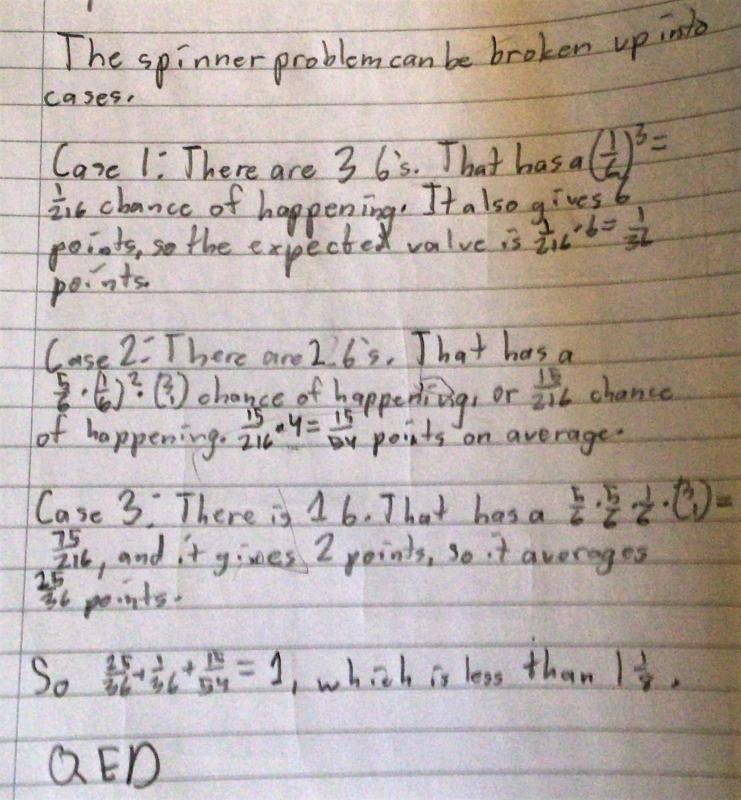
Sanika's work is longer and considers each spinner separately. Click here to see Sanika's work on the coins and the spinners, including an exploration of what happens if it costs one point to play each game.
Teachers' Resources
Using NRICH Tasks Richly describes ways in which teachers and learners can work with NRICH tasks in the classroom.
Why do this problem?
This problem offers an opportunity to explore and discuss two types of probability: experimental and theoretical. The simulation generates lots of experimental data quickly, freeing time to focus on predictions, analysis and justifications.
Possible approach
This problem follows on nicely from Cosy Corner
Explain and demonstrate both games by running the interactivities a few times so that students get a feel for the two games, but don't have sufficient results to draw conclusions about the probabilities. Invite students to predict in which game they would expect to win more points, if they played both games the same number of times.
Allow students time in pairs in which to analyse each game, so that they can decide which is likely to offer them the better chance of winning more points, and emphasise that they will need to be in a position to offer supporting evidence for their decision.
While students are working, circulate and observe the methods being used. Bring the class together and choose individuals who used different methods to explain what they did to the class, recording what they did on the board.
Record their conjectures on the board and then run the interactivity for each game a few hundred times.
Then revisit students' conjectures and discuss which ones matched the experimental data. If no groups had a correct conjecture, then get them to refine their methods in groups, if they can. For the coins, students may count each possible number of heads/tails but not count repeats, for example counting H,H,H,T the same as T,H,H,H. You could guide them around this misconception by having them see four different coins (tails on the 5p is different to tails on the 1p).
For the spinners, the simplest method is to treat the three spinners separately, so that on average, they get two points for every six games for each spinner. Alternatively, students might systematically list the possible ways of getting 0, 2, 4 and 6 points. In this case, the spinners game becomes similar to the coins game, especially if you treat the outcomes as {6} and {not 6}.
Bring the students back again for a discussion about what they changed to improve their methods. Common themes should be emerging, so encourage the whole group to work together to explain and justify their own and each others' ideas.
Key questions
How many points do you think you would get if you played 16/6/36/216 times?
What counts as a different outcome?
Possible support
This problem could be tackled as a follow-up to Cosy Corner
Teachers may want to use this recording tool to gather the results of other similar experiments that their students are carrying out:
Possible extension
A follow-up problem could be Odds and Evens Made Fair