

Contact


Problem
Think about a coin with radius $1$ unit in the corner of a box. I roll the coin along the side of the box, making sure it doesn't slip.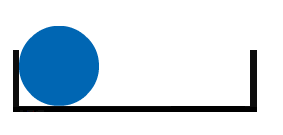
How long would the box need to be for every point on the coin's circumference to touch the box as I roll it along?
Now imagine the coin rolling along two edges of a box like this:
If the two edges are the same length, how long do they need to be to ensure every point on the circumference touches? What if they're not the same length?
Now imagine rolling the coin around on a rectangular tray so that the edge of the coin is always in contact with the inside wall of the tray, and so that it always rolls and never slides. What proportion of the circumference touches the tray as it makes one complete circuit of a $4$ by $3$ tray?
Can you draw any diagrams to help to explain your thinking?
What is the smallest tray you can find where all of the circumference touches the tray at some point?
Getting Started
|
When the disc is in the corner there is one quarter of the
circumference (that is a length $2\pi/4 = \pi/2$) which does not
come in contact with the edge of the tray. As the disc rolls round
one circuit:
an arc of length $2$ units comes into contact,
then an arc of length $\pi/2$ gets missed,
then an arc of length $1$ unit comes into contact,
then an arc of length $\pi/2$ gets missed,
then an arc of length $2$ units comes into contact,
then an arc of length $\pi/2$ gets missed,
then an arc of length $1$ unit comes into contact.
|
Image

|
Some points never touch, other points touch only once, other points touch twice.
As an extension to this problem, can you now work out how much of the circumference of the disc never touches the edge of the tray?
The article 'A Rolling Disc' discusses variations of this problem.
Student Solutions
Well done Sam from Kings Wimbledon for your solution:
1) Coin radius 1: How long would the box need to be for every point on the coin's circumference to touch the box as I roll it along?
The left bottom quarter of the disc is not in contact, which is
a radius' width. Then the whole circumference must roll along the
base of the box, until another quarter of circumference is not in
contact in the bottom right and corner.
So the disc must be two radii (from when the disc is at the sides)
plus one circumference long. This is
$l=1+1+(2\times\pi\times1)=2(1+\pi)=8.28$.
For any radius $r$, the length of the box is
$l=r+r+(2\times\pi\times r)=2(r+\pi)$
Call the length of the edges $l$. Then the amount of the
circumference that touches each edge is $l-r$, as at the corner
there will be a quarter of the circumference that will not be
touched.
Obviously if $l-r> c$ then the whole circumference will touch
both edges, so we want to find the minimum length an edge can have
to touch the whole circumference. So you need
$2\times(l-r)+\frac{2\pi r}{4}=2\times(l-r)+\frac{\pi
r}{2}=2\times(2\pi r)$
$2\times(l-r)=\frac{7}{2} \times \pi r$
$l=\frac{7}{4} \times \pi r +r$
$l=r\times(\frac{7}{4}\pi + 1)$
That is, $\frac{7}{8}$ of the circumference, and then plus the
extra radius that is missed in the corner.
For edges of different lengths, obviously if both lengths are at
least as long as $r\times(\frac{7}{4}\pi + 1)$ then it will work,
and the whole circumference will be covered.
But the more interesting question is, if one of the edges is
shorter than this figure, how long will the other need to be to
make up for it, and ensure the whole circumference is still
touched.
The answer is that if one length is less than
$r\times(\frac{7}{4}\pi + 1)$, then the other length must be the
entire circumference plus the extra radius lost in the corner. This
can be seen from labeling four equidistant points on the disc and
studying their movement as the disc rotates around the edges.
3) Rectangular tray: What proportion of the circumference touches the tray as it makes one complete circuit of a 4 by 3 tray?
Teachers' Resources
Using NRICH Tasks Richly describes ways in which teachers and learners can work with NRICH tasks in the classroom.
Why do this problem?
Possible approach
Start by asking the learners to consider the question "How far forward would a bicycle travel if its wheels turned through one complete revolution?" Then show the first part of the problem, and ask what the difference is between the bicycle problem and the coin in the box problem - this should make it clear that the corners are key.
Now show the second diagram. Intuition may suggest that if the coin is travelling on two sides, each side would not need to be as long in order to get the whole circumference to touch, but having a corner where part of the circumference doesn't touch makes things interesting! Learners could draw corners on paper and roll a cardboard circle along them, highlighting on their circle the parts
that touch and the parts that don't.
Now look at what happens when the coin rolls around the inside of a tray. Ask the learners to discuss in pairs whether all of the circumference of the coin will touch on one circuit of a $4$ by $3$ tray, and then share ideas.
Key questions
Possible extension
Try the problem Five Circuits, Seven Spins.
There are more ideas, explanations and problems to work on in the article A Rolling Disc.
How many times does the disc rotate about its own centre when it makes one revolution around the tray?
What happens if corners are not $90^\circ$?
Possible support
Physically manipulating a circular object inside a frame can make it clearer what's happening at the corners.
The problem Rolling Around may be a good starting point.