

Shapely Pairs


A game in which players take it in turns to turn up two cards. If they can draw a triangle which satisfies both properties they win the pair of cards. And a few challenging questions to follow...
Problem
Shapely Pairs printable sheet - triangle cards
Shapely Pairs printable sheet - quadrilateral cards
For this challenge, you will need to print out a set of triangle cards.
The first part is a game for two or more players; then there are some questions you can think about.
This type of game is played with lots of different sorts of cards; you might have heard it called Pairs, or Pelmanism. To play this version of the game, shuffle the cards and then lay them face down on the table, arranged in rows. Players take it in turns to turn over two cards. If the player can draw a triangle with the two properties shown, then s/he takes the cards. If not, once all the players have had a chance to look at the two cards and see where they belong, the cards are turned back over. Of course it will help you if you can remember where the cards are! The game finishes when no matter which two cards are turned over, there is no triangle with both of those properties. The winner is the person with the most cards at the end of the game. Good luck!

Now here are some questions to get you thinking. Use the triangle cards for these.
Suppose instead of having the cards face down we have them all face up. If it's your turn first, how many possible pairs of cards are there that you could choose and win (that is, in how many ways could you choose a pair so that there is a triangle with both the properties)? Can you list all the possible pairs?
At the end of the game, you might be left with some cards that can't be paired up. What's the largest number you could be left with like this? What's the smallest? Give examples for each.
Now suppose that you want to make a pile of cards so that no matter which two you pick, you can always draw a triangle with both those properties. How big could the pile be? Can you give an example?

This problem is based on the Triangle Property Game from "Geometry Games", a photocopiable resource produced by Gillian Hatch and available from the Association of Teachers of Mathematics
Getting Started
You're going to have to come up with a system to make sure that you don't miss out any pairs, and to make sure that you don't count any twice. You could pick one card and see how many other cards could be paired with it, to get you started.
Is it possible to pair all the cards? Try playing around with different possibilities. You might have to pair up some cards first, if they don't have many possible partners.
Student Solutions
Shubhangee, Abheer, Hari, Ashlesha, Asma, Dia, Jamal, Aman, Adhrit, Akhil, Siddhanth, Harshad, Lasya, Kivisha, Ruhaan, Eshaan, Anirved, Saba and Ayaan from Ganit Kreeda, Vicharvatika in India and Ci Hui from Queensland Academy of Science Mathematics and Technology in Australia numbered the triangle cards, and noted what types of triangle would work for each card. This is the work from Ganit Kreeda:

Suppose instead of having the cards face down we have them all face up. If it's your turn first, how many possible pairs of cards are there that you could choose and win (that is, in how many ways could you choose a pair so that there is a triangle with both the properties)? Can you list all the possible pairs?
Ci Hui thought about this for each type of triangle. First, Ci Hui drew all the different types of triangle onto a Venn diagram, with a list of statements that apply to each type of triangle. Then, for each type of triangle, Ci Hui listed all of the pairs of cards for which you could draw that triangle. This is Ci Hui's work (click on the image to open a larger version):
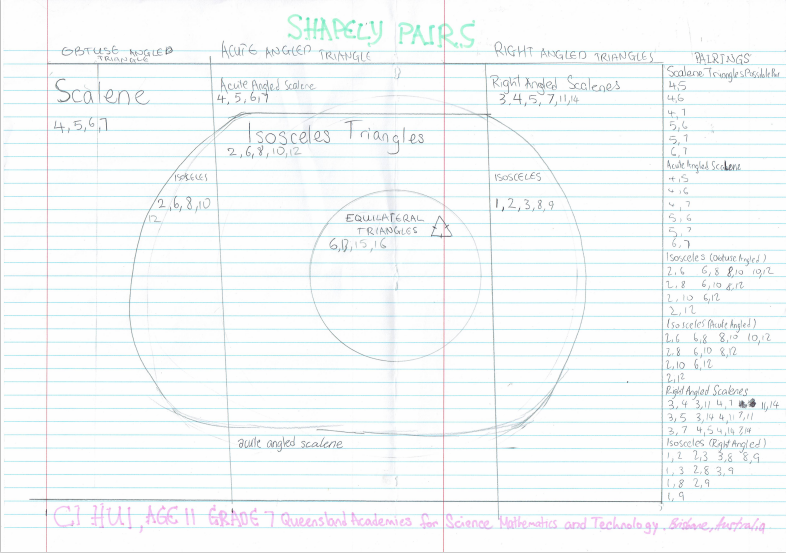
Now suppose that you want to make a pile of cards so that no matter which two you pick, you can always draw a triangle with both those properties. How big could the pile be? Can you give an example?
Similar to Ci Hui's work, the students from Ganit Kreeda considered the different types of triangle. This is their work:
We grouped them from the type of triangles we got as:
1. Isosceles Right-angled Triangle - 6 cards
- Contains a right angle and has just 2 equal angles (1)
- Has just 2 equal sides (2)
- Contains a right angle (3)
- Has just 2 equal angles (8)
- Contains a right angle and has just 2 equal sides (9)
- Has only 1 line of symmetry (12)
2. Isosceles but not Right-angled Triangle - 5 cards
- Has just 2 equal sides (2)
- Does not contain a right angle (6)
- Has just 2 equal angles (8)
- Does not contain a right angle and has just 2 equal sides (10)
- Has only 1 line of symmetry (12)
3. Right-angled Scalene Triangle - 6 cards
- Contains a right angle (3)
- All its angles are of different sizes (4)
- Has no line of symmetry (5)
- All its sides are of different lengths (7)
- Contains a right angle and has all its sides of different lengths (14)
- Contains a right angle but does not have a line of symmetry (11)
4. Equilateral Triangle - 4 cards
- Has all its sides equal (13)
- Does not contain a right angle (6)
- Has three lines of symmetry (15)
- Has all its angles equal (16)
Teachers' Resources
Using NRICH Tasks Richly describes ways in which teachers and learners can work with NRICH tasks in the classroom.
Why do this problem?
The game provides a powerful and engaging context for working on properties of triangles/quadrilaterals. Two other related problems are Quadrilaterals Game and Property Chart
Possible approach
This game can easily be played in groups. After a brief demonstration to clarify the rules, ask students to play the game in groups. To encourage discussion and peer support, ask students to play as pairs; both must agree on the "final answer" before it counts. Again, to spread ideas and strategies around the class, you could organise a rotation or two so that all pairs move on and play a new pair.
Key questions
- How many different sorts of triangle can be used to fit a particular card?
- Is your opponents' drawing clear, correct and convincing?
Possible support
Share out two or three sets of the cards (or big A4 versions) among all the students in the class, show a triangle on the board and ask students to stand if they have a card that describes it. The duplication of cards should generate useful conflict if people with the same card disagree.
It might be useful to have a worksheet available with lots of different triangles as 'ideas' or to save some students having to draw the shapes.
Possible extension
- How many triples of cards lead to possible triangles?
- What is the greatest number of cards which will all apply to the same triangle?
- Make your own version of this game, deciding what to put on the cards.