

Multiply the Addition Square


If you take a three by three square on a 1-10 addition square and multiply the diagonally opposite numbers together, what is the difference between these products. Why?
Problem
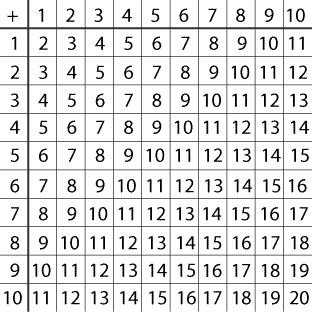
Take an addition table from $1$ to $10$ (or any other that you like better!):
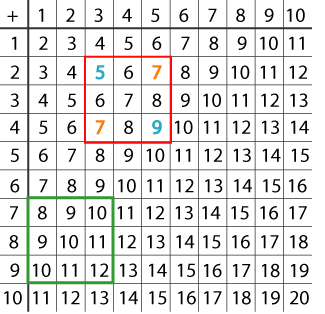

$5 \times 9 = 45$
$7 \times 7 = 49$

Getting Started
How do the four numbers compare in size?
Try comparing the number in the top left corner of a square with the other three numbers.
So what happens when these numbers are multiplied in the way described?
You may like to print off this addition square to try out your ideas.
Student Solutions
Mr Skipper (who didn't send us his first name) was the first to send in a solution:
Wherever we place the square, the number in the top left corner is the smallest.
Call this $n$.
The arbitrary square becomes
n n+1 n+2
n+1 n+2 n+3
So the product of the top left and bottom right is
The product of the top right and bottom left is
(n+2)^2 = n^2 + 4n + 4.
(n^2 + 4n + 4) - (n^2 + 4n) = 4.
Annette aged 13 did really well and generalised the problem still further. She considered what would happen if you had any sized square on the same addition grid.
Annette talks about the size of the square to be N by N, and the first number in the top left of the square to be k.
since k=number in top left then
Teachers' Resources
Using NRICH Tasks Richly describes ways in which teachers and learners can work with NRICH tasks in the classroom.
Why do this problem?
This problem is a good one for building on the learners' ability to recognise number properties and reason about numbers. It is easy for all at the start as it only requires simple multiplication and subtraction and gives the satisfaction of finding a pattern. If the results are generalised algebraically it can prove a real challenge.
Possible approach
Key questions
Possible extension
Learners could try to generalise, not only the results for $3 \times 3$ squares but also those for all squares on this grid. Alternatively, they could try the same procedure with rectangles rather than squares or use other grids such as multiplication squares.
Possible support
Suggest using a calculator for the multiplication and subtraction or, alternatively, switch to Diagonal Sums which is a similar, but easier, problem.