Copyright © University of Cambridge. All rights reserved.
'Palindromes' printed from https://nrich.maths.org/
Show menu
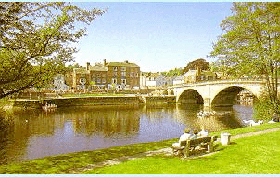
I was in Bewdley, in Worcestershire recently. It's a very old town and well known for a pretty bridge over the river in the centre of town. But it's also known for another reason, one that most people don't know about. Mr Edward Benbow, from Bewdley, once held the palindromic record! "The what?" you may be asking.
A palindrome is a word, sentence or verse that reads the same forward or backwards, that is to say from right to left and left to right. EVE and ANNA are both short palindromic names, then there's HANNAH and BOB. You probably have some palindromic people in your family! Not sure? Well how about MUM or DAD, and you might even have a SIS!

Was it a car or a cat I saw? The letters need a little adjusting, but that is a palindromic sentence, or rather question.
Mr Benbow put together 22,500 words to make a "palindromic composition"! They don't make a great deal of sense but that's a lot of words to read backwards.
Numbers can also be palindromes. For instance 121, this can be read back wards or forwards. Palindromic numbers are very easy to create from other numbers with the aid of addition.
Try this:
1. Write down any number that is more than one digit. (e.g. 47)
2. Write down the number reversed beneath the first number. (47+74)
3. Add the two numbers together. (121)
4. And 121 is indeed a palindrome.

Try a simple one first, such as 18.
Sometimes you need to use the first addition answer and repeat the
process of reversing and adding.
You will nearly always arrive at a palindrome answer within six steps. Try one of these numbers 68 or 79.
If you choose a number greater than 89 arriving at the palindrome answer takes more steps but it still works.
But don't try 196! In fact, avoid it like the plague.... A computer has already gone through several thousand stages and still hasn't come up with a palindrome answer!
I wonder if you can think how many 2 digit palindromes there are? How about finding all of the 3, 4, 5 or 6 digit ones? How about to a million digits! Some people have already beaten you to that, you'll be glad to know. You can find the results of their work on the web here .
Don't get palindromes mixed up with inversions . Inversions describe numbers that read the same upside down as the right way up. Look at these examples:

Can you think which year in the last century read the same when inverted? How about a year in the century before last? When will the next one occur?
So how and where did the idea of Palindromes come from? Well we know a great deal more about word palindromes. The word itself is from the Greek palindromus , which means to run back again. The  first palindromes that were
made up by organising groups of words not letters. A Greek poet, Sotades , who lived in Egypt in about 276BC during the reign of Ptolemy II, wrote a palindrome about the king which wasn't appreciated. Poor old Sotades was sealed in a box and cast out to sea for his efforts. Palindromes are found written in Egyptian hieroglyphics and in Latin texts. Despite quite a search, I have not been able to
uncover anything significant about the history of the number palindrome. There is a journal written especially for people who are passionate about palindromes and there are many, many palindrome web sites. Some provide information on the findings of mathematicians who investigate how they can be formed and the patterns found when they create palindromes. Other sites provide palindrome puzzles and
problems for you to solve. Maybe you can become the new Harvey Duner who, from July 18th 2001, became a record breaker with a palindrome prime of 39,027 digits. What can we say Harvey, except it could have been 39,093 digits!
first palindromes that were
made up by organising groups of words not letters. A Greek poet, Sotades , who lived in Egypt in about 276BC during the reign of Ptolemy II, wrote a palindrome about the king which wasn't appreciated. Poor old Sotades was sealed in a box and cast out to sea for his efforts. Palindromes are found written in Egyptian hieroglyphics and in Latin texts. Despite quite a search, I have not been able to
uncover anything significant about the history of the number palindrome. There is a journal written especially for people who are passionate about palindromes and there are many, many palindrome web sites. Some provide information on the findings of mathematicians who investigate how they can be formed and the patterns found when they create palindromes. Other sites provide palindrome puzzles and
problems for you to solve. Maybe you can become the new Harvey Duner who, from July 18th 2001, became a record breaker with a palindrome prime of 39,027 digits. What can we say Harvey, except it could have been 39,093 digits!