Copyright © University of Cambridge. All rights reserved.
'The Moving Planets' printed from https://nrich.maths.org/
Show menu
Since people first looked up and wondered what the lights in the sky were, we have tried to solve the mysteries of the stars and planets. Mathematics has always been a powerful tool for studying, measuring and calculating the movements of the planets. So mathematics was used to both discover, then prove the first basic `rule' of our planets - that they travel around the sun, not around Earth. In
the 1500's and 1600's, now famous men such as Nicolaus Koppernik ( Copernicus ), Isaac Newton and Galileo Galilei worked hard to convince the authorities of this truth.
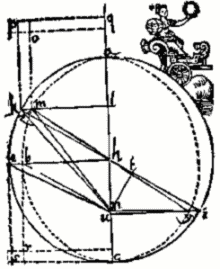
Between 1609 and 1618 Johannes Kepler announced his laws of planetary motion. Using the careful observations recorded by Tycho Brahe , he showed that the shape of a planet's path around the sun (orbit) was an ellipse (almost a circle). He calculated the
speed that each planet travelled. He also worked out the relation between size of the orbit and the time it takes for the planet to go once around the sun (revolution).
Eclipse of the Sun