nrich
enriching mathematics
Skip over navigation
Home
Home
Students
Guide and features
Teachers
Guide and features
STEM
Science, Technology, Engineering and Mathematics
AskNRICH
Forum
early years
Featured Early Years Foundation Stage; US Kindergarten
Early years
primary
Featured UK Key Stage 1&2; US Grades 1-4
Primary teachers
secondary
Featured UK Key Stage 3-5; US Grades 5-12
Secondary teachers
primary lower
Featured UK Key Stage 1, US Grade 1 & 2
primary
primary
Featured UK Key Stage 2; US Grade 3 & 4
secondary lower
Featured UK Key Stages 3 & 4; US Grade 5-10
secondary
secondary upper
Featured UK Key Stage 4 & 5; US Grade 11 & 12
Topics
translate
Problem
Getting Started
Solution
Teachers' Resources
Printable page
You may also like
Mathematical Symbols
A brief article written for pupils about mathematical symbols.
Stone Age Counting
Stage: 1
Challenge Level:
Why do this problem?
The lovely thing about
this problem
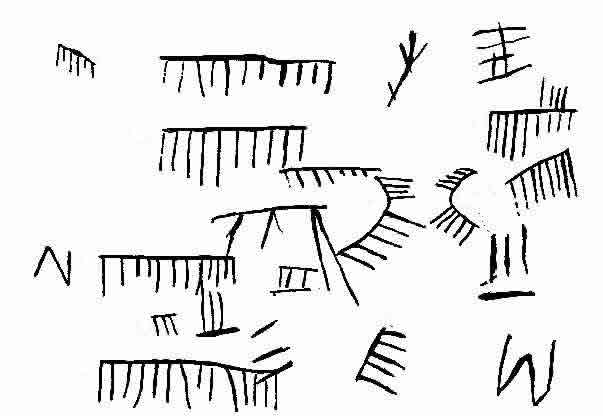
is that it does not have a 'right' answer as such and therefore it is a great context in which children can be creative and uninhibited. It is a fantastic opportunity for you to encourage learners to justify their hypotheses.
Possible approach
Project
the picture
on the screen for the whole group to see. Try to do this in such a way as to obscure any text so that there are no clues as to the meaning of the images. Without saying anything else at all, invite pairs of children to talk about what they think the picture may show. You could give each pair
this sheet
, which has a copy of the picture on it.
Share learners' ideas and, depending on what they say, focus on, or steer them towards, the idea of counting and representing numbers. Once this has been established, you can tell them where the symbols were found and encourage them to work in their pairs to come up with some more detailed explanations of the drawings. Children could annotate the sheet to record their thinking.
In the plenary, discuss pairs' interpretations of the pictures. The important thing is to encourage children to justify their thinking. You may find that some pairs have different ideas about the same symbol which may provoke a healthy argument! The aim would be to try and come up with suggestions for each symbol that don't contradict each other. You could then challenge children to record other numbers in the same way, for example on mini whiteboards.
Key questions
Do you think the length of the lines is important?
Why do you think some of the drawings have curved lines?
What are the similarities and differences between the drawings?
How might you write other numbers?
Possible extension
Children could create their own way of representing numbers and/or they could find out about the La Pileta cave.
Possible support
Some learners may find this task a little overwhelming because there isn't a 'right' answer. They may well need frequent verbal reassurance.
Reading and writing numbers
.
Games
.
Place value
.
Visualising
.
History of number systems
.
Factors and multiples
.
Counting
.
Interactivities
.
Addition & subtraction
.
Working systematically
.