

Reflect Again

Problem
Use the diagram to prove the double angle formula, where $t=\tan \theta$: $$\tan2\theta = {2t\over {1-t^2}},\quad \sin2\theta = {2t\over {1+t^2}},\quad \cos2\theta = {{1-t^2}\over {1+t^2}}$$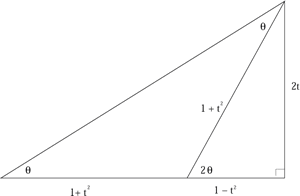
The point $P'=(p',q')$ is the image of the point $P=(p,q)$ after reflection in the line $y=mx$. To find $(p',q')$ use the fact that the midpoint of $PP'$ is on the line $y=mx$ and the line segment $PP'$ is perpendicular to the line $y=mx$ and show that $$p'=p\cos2\theta + q\sin2\theta,\ q'=p\sin2\theta - q\cos2\theta\quad (1)$$ where $m=\tan\theta$. Hence establish another proof that the
matrix
$$T_2= \left( \begin{array}{cc} \cos 2\theta &\sin2\theta \\ \sin2\theta &-\cos2\theta \end{array} \right) $$
gives a reflection in the line $y=x\tan\theta$. The point $P''=(p'',q'')$ is the image of the point $P'$ after reflection in the line $y=x\tan\phi$. Apply the transformation $$T_2' = \left(\begin{array}{cc} \cos 2\phi &\sin2\phi \\ \sin2\phi & -\cos2\phi\end{array}\right)$$ to the point $P'=(p',q')$ to find the coordinates of the point $P''$ in terms of $p, q, \theta$ and $\phi$. Hence
show that the combination of two reflections in distinct intersecting lines is a rotation about the point of intersection by twice the angle between the two mirror lines. What is the effect of the two reflections if the lines coincide (i.e. $\theta=\phi$)?
Getting Started
The conditions suggested in the question give you two equations which you can solve to find $p'$ and $q'$. Use the same formulation to give $(p'',q'')$.
The problem 'The Matrix' explains how 2 by 2 matrices are used to give transformations of the plane and how you multiply the position vector of a point by the matrix to find the image of that point under the transformation.
Student Solutions
Andrei Lazanu proved the double angle formulae illustrated in the diagram:
The diagram starts from a right angled triangle, of sides $2t$ and 2 and where consequently $\tan\theta = t$. In this triangle, a line making an angle $\theta$ with the hypotenuse is drawn. This way, an isosceles triangle is formed, and $2\theta$ is the angle exterior to this isosceles triangle. Let the sides DA and DB of this isosceles triangle be $x$\ units. Then the length of DC must be $2-x$ units. Using Pythagoras' Theorem for triangle ADC we find $x$. $$x^2=(2t)^2+(2-x)^2.$$ Hence $x=1+t^2$ and so the length of side DC is $2-(1+t^2)=1-t^2$.
The formulae for the sine, cosine and tangent of $2\theta$ in terms of $t$, where $t=\tan \theta$, follow directly from the ratios of the sides of the right angled triangle ADC and we get $$\tan2\theta = {2t\over {1-t^2}},\quad \sin2\theta = {2t\over {1+t^2}},\quad \cos2\theta = {{1-t^2}\over {1+t^2}}$$
$$T= \left( \begin{array}{cc} cos 2(\phi-\theta) & -sin2(\phi-\theta)\\ sin2(\phi-\theta & \cos2(\phi-\theta) \end{array} \right) $$