Links to the University of Cambridge website
 Links to the NRICH website Home page

Links to the NRICH website Home page
Nurturing young mathematicians: teacher webinars
30 April (Primary), 1 May (Secondary)
30 April (Primary), 1 May (Secondary)
Tandems
Age 7 to 11
Challenge Level 

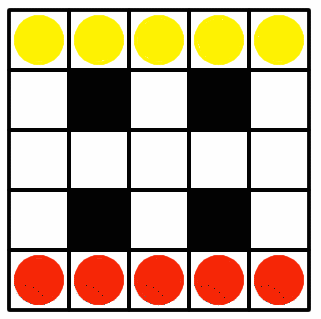
Each player has 5 men in a line on his side of the board. The winner is the first player to get all his men across the board on to the line of squares on the far side.
Players take turns to move. When it is his turn, each player must move two of his men one square each in the SAME direction. The move may be in any direction including diagonally.
Only one man is allowed in any square, there is no jumping and the black squares cannot be used.