

Factor Lines


Arrange the four number cards on the grid, according to the rules, to make a diagonal, vertical or horizontal line.
Problem
Arrange the four number cards (1, 2, 3 and 21) on the grid above to make a diagonal, vertical or horizontal line.
You can put a number card on a square with
- a multiple of that number
- a factor of that number.
In how many different ways can you do it? Can you use a strategy that you haven't tried before?
You can use the interactivity above or this sheet. The interactivity keeps track of the number of different lines you have created and you can view the lines you've already made by clicking 'Show lines'.
This problem has been adapted from the book "Cards on the Table" by Fran Mosley, published by BEAM Education. This book is out of print but can still be found on Amazon.
Getting Started
Student Solutions
Thank you to everybody who shared their ideas about this task with us. Anyu from Bisspuxi in China had an idea about how to start this activity:
I started off listing factors and multiples of 1,2,3 and 21 up to 25 so it was simpler to find the answers.
Good idea, Anyu - those factors and multiples are going to be really important for helping us find solutions to this problem.
Om from St Leonard Primary School in Exeter, UK focused on the factors and multiples of 21. They sent in this picture of their six solutions:
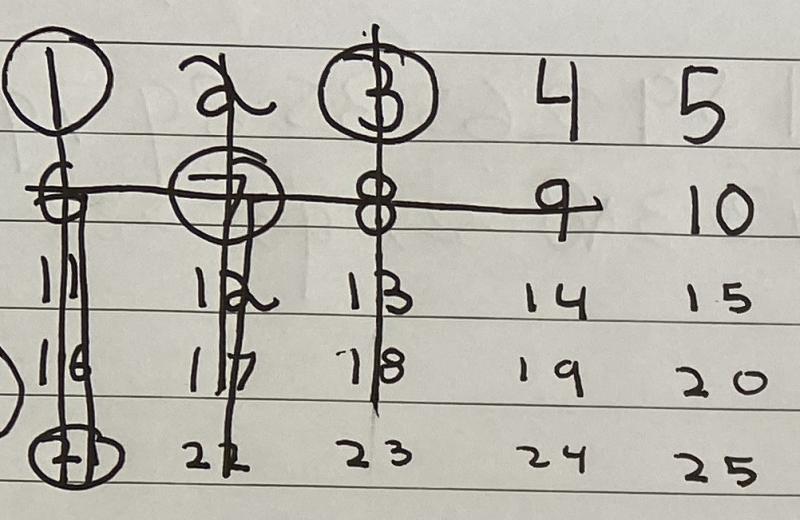
Om has circled the numbers 1, 3, 7 and 21 because as these are the only factors or multiples of 21, every solution must pass through one of these. This is a good idea, Om. I wonder why Om chose to focus on the factors and multiples of 21 rather than 1, 2 or 3?
Amina from St Mary's Catholic Primary School in Bath, UK also began by thinking about the factors of 21:
First of all I noticed that 21 could only be placed on four squares: 7,3,1,21. The 1 could be placed on any square and the 2 can go on any even number. To create the lines I started with 21 then the 3 because these are the hardest numbers to place on the grid. So once I found a place for the 21 and 3, all I had to do is find an even number for the 2 and then the 1 can go on any square because any whole number can be divided by one. I managed to find 9 lines in total. All of my lines were vertical and horizontal because when I looked for diagonal lines I realized I couldn't make one because all the numbers were odd and there was nowhere to put the 2.
This is very clearly explained, Amina - well done.
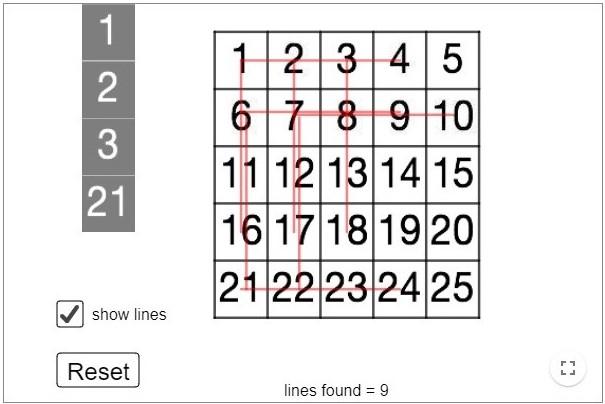
We received quite a few solutions from children who had found nine possible factor lines. Dhruv from The Glasgow Academy, UK sent in this explanation and picture showing the nine possible factor lines:
When I tried all the ways these are the ones I got,
1 6 11 16
21 16 11 6
1 2 3 4
2 7 12 17
22 17 12 7
21 22 23 24
6 7 8 9
10 9 8 7
3 8 13 18.
The trick I used was I knew that 21 could not have had any multiples in a 5 x 5 table, so I worked out all the factors of 21 and started every line from there. The factors of 21 are 1, 3, 7 and 21, that’s why every line starts from these numbers.
For numbers like 6 and 12 I could have put 1, 2 or 3 because 6 and 12 are multiples of these numbers but I had to think carefully as some of the numbers (in the lines) could only be multiples of 3 or 2.
I ended up with 9 lines and could not make any more.
It sounds like you thought really carefully about this, Dhruv - well done!
Some children thought about the different possible ways of making each factor line, as well as how many factor lines were possible to make. The children at Our Lady's & St. Oswald's Catholic Primary School, UK sent us this picture:
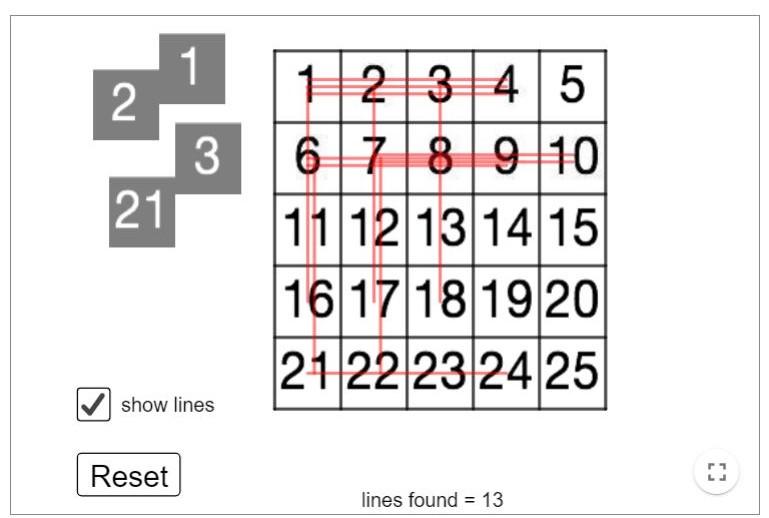
They said:
We found 13 solutions, are there any more?
We worked systematically by focusing on factors and multiples of 21 first.
This seems to be a popular strategy! In the picture above, the children have put multiple lines on some of the solutions because there are different ways of making them using factors or multiples of the numbers 1, 2, 3 and 21. For example, in the factor line 1 2 3 4, either the 1 or the 3 can be used as a factor of 21.
There are actually more than 13 solutions if we consider each of the different ways of making a factor line to be a different solution. Anyu from Bisspuxi in China said:
I found 15 in total.
I also think there are 15 solutions in total, Anyu. We asked if anybody could send us the full list of 15 solutions, and we received these images from Dhruv describing the full solution:
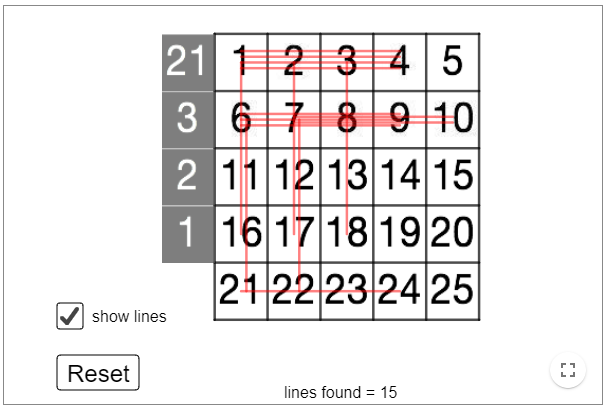
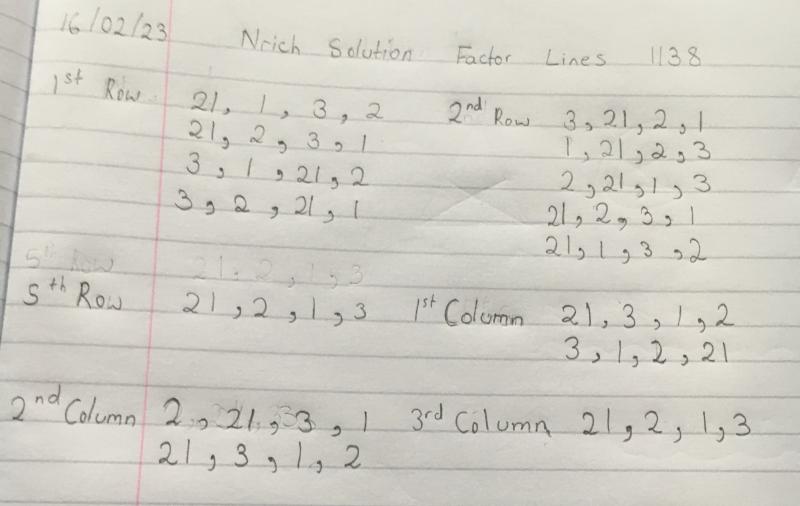
Thank you, Dhruv, for your perseverance in finding all fifteen solutions!
Teachers' Resources
Using NRICH Tasks Richly describes ways in which teachers and learners can work with NRICH tasks in the classroom.
Why do this problem?
Possible approach
Key questions
Possible extension
Possible support