

Teddy Town


There are nine teddies in Teddy Town - three red, three blue and three yellow. There are also nine houses, three of each colour. Can you put them on the map of Teddy Town according to the rules?
Problem
In Teddy Town, teddies are either red or yellow and they live in red or yellow houses. There are 4 teddies - 2 red and 2 yellow, and 4 houses - 2 red and 2 yellow.
Can you match each teddy to a house so that the 4 pairs are all different from each other?
Imagine now that there are 3 different colours of teddies and houses - red, yellow and blue. In Teddy Town there are now 9 teddies and 9 houses. All 9 pairs of houses and teddies are different from each other.
Here is a map showing Teddy Town:
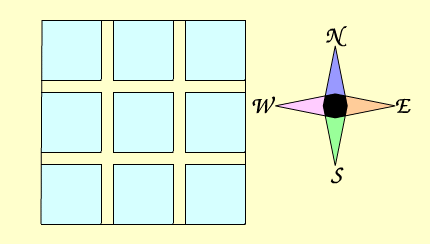
The streets are very special. If you walk along a street from east to west, or west to east, all the houses are a different colour and the teddies living in the houses are a different colour too. The same is true if you walk along the streets in a north-south or south-north direction.
In other words, looking at the map grid, each row and column must have different coloured houses and different coloured teddies.
Can you arrange the houses and teddies on the map grid, making sure that all 9 pairs of houses and teddies are different from each other?
Teddy Town is expanding rapidly as green teddies move to the area and green houses are built. Now there are 16 teddies and 16 houses.
There are 16 different ways to combine the teddies and houses. How could these 16 households be organised on the map now? Remember that in each row and column there must be both different coloured houses and teddies.
Now... yes, you've guessed it. Another colour of teddy bear has moved to Teddy Town. As well as red, yellow, blue and green teddies there are now purple teddies. Of course, this means that purple houses will have to be built. So, now in Teddy Town there are 5 of each colour bear, making 25 teddies in all, and also 25 houses, again 5 of each colour.
Can you make the 25 different combinations of teddy and house now? Arrange these on the street map below in the same way as before:
Teddy Town part four
Teddy Town is becoming very overcrowded! However, there is just enough room for some turquoise teddies to join. Living there now are 36 teddy bears: 6 red, 6 yellow, 6 blue, 6 green, 6 purple and 6 turquoise. There are 36 houses for them to live in: 6 red, 6 yellow, 6 blue, 6 green, 6 purple and 6 turquoise.
Make the 36 combinations of teddies and houses. Do you think it will be possible to put these 36 combinations in the street grid? Maybe it won't be. Have a go!
Now, look back at what you have done and ask yourself some of these questions:
- Was it easier to arrange the combinations in some of the grid sizes compared with others?
- Why do you think this is?
- What was your strategy for solving the arrangement puzzle each time?
- What would happen if the two diagonals on the map also had to have different coloured houses and different coloured teddies? Can you solve the problem for each street plan now?
Printable NRICH Roadshow resource.
Acknowledgements
This activity is based on a Bernard's Bag problem from December 1997 called Tea Cups. The idea for the teddies came from Andrew Massey who is an Advisor for Worcestershire County Council. Thank you!
Getting Started
You could use counters or pieces of coloured card if you don't have teddies.
Have you checked your combinations are all different?
Student Solutions
Clara from the United World College Singapore wrote:
If I was doing 4 houses and 4 teddies, I would make 2 of the houses red and the other 2 houses blue. And the 4 teddies, 2 red and the other 2 blue. I would put 1 of the red teddies in the blue House, and put 1 of the blue teddies in the red house. Then I would put the other two teddies in the opposite house.
Tim has been very busy arranging teddies. He sent us pictures of his arrangements. Well done Tim!


Tim said that he couldn't arrange the houses and teddies on the map when there were six colours, but he wasn't sure why. In fact, this is quite a famous problem. You can read about it on the NRICH site or at www.cut-the-knot.org, for example (our teddy bear problem is equivalent to finding two orthogonal Latin squares of different orders).
Teachers' Resources
Using NRICH Tasks Richly describes ways in which teachers and learners can work with NRICH tasks in the classroom.
Why do this problem?
Possible approach
Key questions
Possible support
Some children might find it easier to work out all the possible combinations of houses and teddies before putting them onto the grid - others might prefer to put all of the houses onto the grid first and then put the teddies on afterwards. If pupils are finding it difficult to check their solutions, they might benefit from using a checking mechanism for the first grid:
Possible extension